Slide 1 of 1 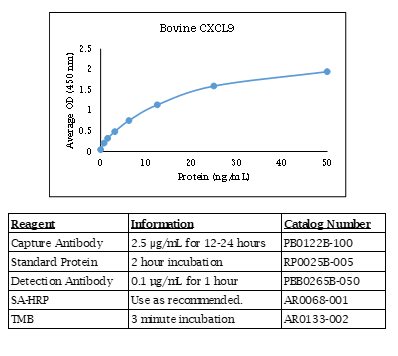
Bovine CXCL9 (MIG) ELISA
- Catalog Number:
- DIY0661B
- Availability:
- In stock
- Application:
- ELISA
- 100% Homology:
- Bison bison bison (American buffalo), Bos grunniens (domestic yak), Bos indicus (zebu), Bos mutus (wild yak), Bos taurus (cattle)
 Powered by Bioz
 Components
| Usage | Quantity | Component | Size |
|---|---|---|---|
| Detection Antibody | 50 µg | PBB0265B-050 | |
| Standard | 5 µg | RP0025B-005 | |
| Capture Antibody | 100 µg | PB0122B-100 | 1 Pack (<= 10 Plates) |
| Capture Antibody | 100 µg X 2 | PB0122B-100 | 1 Pack (<= 20 Plates) |
- The Bovine CXCL9 (MIG) ELISA is designed for the quantitative measurement of bovine CXCL9 in cell culture supernatants. With minor modifications to the assay procedure, this ELISA can also be used to measure CXCL9 in additional biological sample types, including serum, plasma, and tissue lysates, providing flexibility for a wide range of immunology and translational research applications. This Bovine CXCL9 ELISA demonstrates cross-reactivity with Yak, American Buffalo, and Zebu CXCL9, making it well suited for comparative immunology studies involving related species. The kit contains a capture antibody, detection antibody, and recombinant protein standard for assay development. These antibodies have been validated to function together in an ELISA format using the provided standard. Optimal buffers, antibody concentrations, incubation times, temperatures, and assay conditions have not been predetermined, allowing researchers to optimize assay sensitivity and dynamic range based on their specific sample type and experimental needs. The quantities of kit components are not matched, and individual components may be purchased separately. This product is for research use only and is manufactured in the USA.
| Storage Conditions | 2°C to 8°C or -20°C |
| Country Of Origin | USA |
Bovine CXCL9 (C-X-C motif chemokine ligand 9), also known as MIG (monokine induced by interferon-γ), is a proinflammatory chemokine belonging to the CXC chemokine family, which also includes CXCL10 (IP-10) and CXCL11 (I-TAC) that regulate T-cell recruitment during interferon-driven immune responses. In cattle (Bos taurus), CXCL9 is produced by macrophages, dendritic cells, endothelial cells, and epithelial cells in response to interferon-γ (IFN-γ) and other inflammatory stimuli during infection or immune activation. CXCL9 signals primarily through the chemokine receptor CXCR3, expressed on activated T lymphocytes, natural killer (NK) cells, and other immune cells, promoting chemotaxis and accumulation of these cells at sites of infection or inflammation. In bovine health, CXCL9 contributes to cell-mediated immune responses against intracellular pathogens, including those responsible for diseases such as bovine tuberculosis caused by Mycobacterium bovis, where CXCL9 helps recruit Th1-type T cells and NK cells to infected tissues. Because of its role in interferon-regulated immune responses and T-cell trafficking, bovine CXCL9 is studied in veterinary immunology, infectious disease research, and vaccine development, particularly in investigations of host immune responses to mycobacterial infections and other intracellular pathogens in cattle.
Citations
Please choose a size to see price
RELATED MEDIA
