Slide 1 of 1 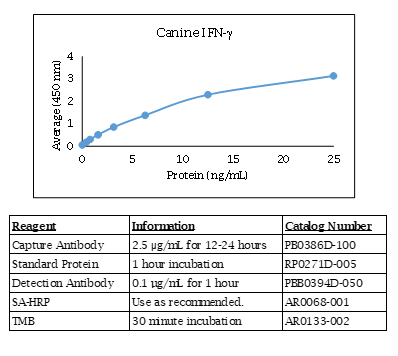
Canine IFN gamma ELISA
- Catalog Number:
- DIY0677D
- Availability:
- In stock
- Application:
- ELISA
- 100% Homology:
- Canis lupus dingo (dingo), Canis lupus familiaris (dog), Nyctereutes procyonoides (raccoon dog), Vulpes lagopus (Arctic fox), Vulpes vulpes (red fox)
 Powered by Bioz
 Components
| Usage | Quantity | Component | Size |
|---|---|---|---|
| Detection Antibody | 50 µg | PBB0394D-050 | |
| Standard | 5 µg | RP0271D-005 | |
| Capture Antibody | 100 µg | PB0386D-100 | 1 Pack (<= 10 Plates) |
| Capture Antibody | 100 µg X 2 | PB0386D-100 | 1 Pack (<= 20 Plates) |
- The Canine IFN-γ (Interferon-gamma) ELISA is designed for the quantitative measurement of canine IFN-γ in cell culture supernatants. With minor modifications to the assay procedure, this ELISA may also be used to measure IFN-γ in additional biological sample types reported in the literature, including serum, plasma, whole blood, peripheral blood mononuclear cell (PBMC) culture supernatants, and tissue homogenates or lysates, depending on the experimental model and physiological context. This flexibility supports a wide range of immunology and translational research applications. Reported measurements: Canine IFN-γ has been detected in serum (~0.1-5 ng/mL), plasma (~0.05-2 ng/mL), and PBMC culture supernatants (~10-200 pg/mL under stimulation conditions), although levels vary depending on immune activation, infection status, and sample handling. Interferon-gamma (IFN-γ) is a type II interferon produced primarily by activated T lymphocytes and natural killer (NK) cells. It plays a central role in cell-mediated immunity, antiviral defense, macrophage activation, and Th1 immune responses. Measurement of IFN-γ is widely used to assess immune activation, vaccine response, infection progression, and inflammatory signaling in canine and related species. IFN-γ serves as an important biomarker of adaptive immune activation and disease progression, supporting studies in veterinary immunology, comparative immunology, and translational research. IFN-γ is a member of the type II interferon family, which includes other species-specific IFN-γ proteins involved in immune modulation, antiviral responses, and macrophage activation. The canine IFN-γ protein is 100% homologous to Arctic Fox (Vulpes lagopus), Dingo (Canis dingo), Red Fox (Vulpes vulpes), and Raccoon Dog (Nyctereutes procyonoides) IFN-γ, making this ELISA well suited for studies involving these species and closely related animals where sequence identity supports cross-species detection. The kit contains a capture antibody, detection antibody, and recombinant protein standard for assay development. These antibodies have been validated to function together in an ELISA format using the provided standard. Optimal buffers, antibody concentrations, incubation times, temperatures, and assay conditions have not been predetermined, allowing researchers to optimize assay sensitivity and dynamic range based on their specific sample type and experimental requirements. The quantities of kit components are not matched, and individual components may be purchased separately. This product is for research use only and is manufactured in the USA.
| Storage Conditions | 2°C to 8°C or -20°C |
| Country Of Origin | USA |
Canine Interferon-Gamma (IFN-γ) is a type II interferon produced primarily by activated CD4⁺ and CD8⁺ T lymphocytes and natural killer (NK) cells in dogs (Canis lupus familiaris), where it plays a central role in cell-mediated (Th1-type) immunity against intracellular pathogens. IFN-γ signals through the IFN-γ receptor complex (IFNGR1/IFNGR2), activating JAK/STAT1 pathways and inducing genes involved in macrophage activation, enhanced antigen presentation via upregulation of MHC class I and II molecules, nitric oxide production, and promotion of cytotoxic T-cell responses. In canine health, IFN-γ is critical for defense against pathogens such as Leishmania infantum, Mycobacterium spp., canine distemper virus, and certain tick-borne intracellular organisms, and its expression levels are often associated with protective Th1 immune responses and vaccine efficacy. Dysregulated or insufficient IFN-γ responses can contribute to chronic infection, immune-mediated disease, or altered inflammatory balance. In translational research, dogs serve as valuable spontaneous models for human infectious diseases (e.g., leishmaniasis), autoimmune conditions, and certain cancers, and characterization of canine IFN-γ supports studies of T-cell function, immune modulation, vaccine development, and comparative cell-mediated immunity relevant to both veterinary medicine and human health.
Citations
Please choose a size to see price
RELATED MEDIA
