Slide 1 of 1 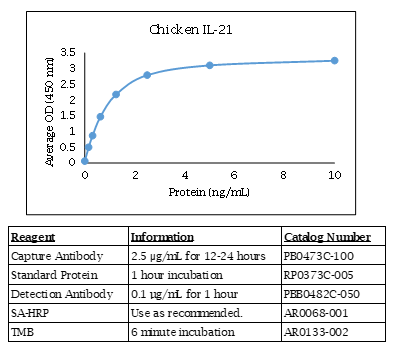
Chicken IL-21 ELISA
- Catalog Number:
- DIY0688C
- Availability:
- In stock
- Application:
- ELISA
- 100% Homology:
- Gallus gallus (chicken)
 Powered by Bioz
 Components
| Usage | Quantity | Component | Size |
|---|---|---|---|
| Detection Antibody | 50 µg | PBB0482C-050 | |
| Standard | 5 µg | RP0373C-005 | |
| Capture Antibody | 100 µg | PB0473C-100 | 1 Pack (<= 10 Plates) |
| Capture Antibody | 100 µg X 2 | PB0473C-100 | 1 Pack (<= 20 Plates) |
- The Chicken IL-21 (Interleukin-21) ELISA is designed for the quantitative measurement of chicken IL-21 in cell culture supernatants. With minor modifications to the assay procedure, this ELISA may also be used to measure IL-21 in additional biological sample types reported in the literature, including serum, plasma, peripheral blood mononuclear cell (PBMC) culture supernatants, and tissue homogenates or lysates, depending on the experimental model and physiological context. This flexibility supports a wide range of immunology and translational research applications. Reported measurements: Chicken IL-21 has been detected in serum (~20-300 pg/mL), plasma (~15-250 pg/mL), and PBMC culture supernatants (~50-600 pg/mL under stimulation conditions), although levels vary depending on immune activation, infection, or experimental treatment. Interleukin-21 (IL-21) is a cytokine primarily produced by activated CD4⁺ T cells, including T follicular helper (Tfh) and Th17 subsets. It plays a central role in B-cell differentiation, antibody production, NK cell activation, and modulation of T-cell responses. Measurement of IL-21 is widely used to assess adaptive immune activation, humoral immunity, and T-cell-B-cell interactions in chicken and related species. IL-21 serves as an important biomarker of immune system function, vaccine responses, and immune regulation, supporting studies in avian immunology, comparative immunology, and translational research. Why measure IL-21: Quantifying IL-21 provides insight into humoral immune responses, T-cell-B-cell communication, and the overall status of adaptive immunity. It is commonly used to evaluate vaccine efficacy, infection response, and immunomodulatory treatments in poultry research. IL-21 is a member of the common gamma-chain (γc) cytokine family, which also includes IL-2, IL-4, IL-7, IL-9, and IL-15. These cytokines are involved in lymphocyte development, proliferation, and immune regulation, with IL-21 playing a particularly important role in B-cell and NK-cell function. The kit contains a capture antibody, detection antibody, and recombinant protein standard for assay development. These antibodies have been validated to function together in an ELISA format using the provided standard. Optimal buffers, antibody concentrations, incubation times, temperatures, and assay conditions have not been predetermined, allowing researchers to optimize assay sensitivity and dynamic range based on their specific sample type and experimental requirements. The quantities of kit components are not matched, and individual components may be purchased separately. This product is for research use only and is manufactured in the USA.
| Storage Conditions | 2°C to 8°C or -20°C |
| Country Of Origin | USA |
Chicken IL-21 (Interleukin-21) is a cytokine of the common γ chain (γc) family that plays an important role in regulating adaptive immune responses in chickens (Gallus gallus). IL-21 is produced primarily by activated CD4⁺ T cells, particularly T follicular helper (Tfh)-like and Th17-like cells, following antigen stimulation. It signals through the IL-21 receptor (IL-21R) in association with the common γ chain, activating downstream JAK/STAT pathways—especially STAT3—to regulate gene expression in target immune cells. IL-21 promotes B cell proliferation, differentiation, and antibody production, supports cytotoxic T lymphocyte responses, and enhances natural killer (NK)-like cell activity, thereby contributing to both humoral and cell-mediated immunity. In healthy chickens, basal IL-21 expression is generally low but increases during infection, vaccination, and immune activation. Elevated or dysregulated IL-21 responses have been associated with viral infections such as Marek’s disease virus (MDV), infectious bursal disease virus (IBDV), avian influenza virus, and Newcastle disease virus, as well as parasitic infections including Eimeria spp. (coccidiosis). Chickens serve as important animal models for viral oncogenesis (MDV as a model for herpesvirus-induced tumors), mucosal immunity, and vaccine development. In poultry immunology and translational research, chicken IL-21 is studied as a biomarker of T cell–dependent B cell help and germinal center–like responses and as an indicator of adaptive immune competence in infectious disease and vaccination models.
Citations
Please choose a size to see price
RELATED MEDIA
