Slide 1 of 1 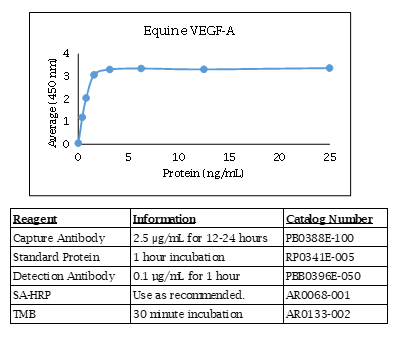
Equine VEGF-A ELISA
- Catalog Number:
- DIY0705E
- Availability:
- In stock
- Application:
- ELISA
- 100% Homology:
- Equus asinus (ass), Equus caballus (horse)
 Powered by Bioz
 Components
| Usage | Quantity | Component | Size |
|---|---|---|---|
| Detection Antibody | 50 µg | PBB0396E-050 | |
| Standard | 5 µg | RP0341E-005 | |
| Capture Antibody | 100 µg | PB0388E-100 | 1 Pack (<= 10 Plates) |
| Capture Antibody | 100 µg X 2 | PB0388E-100 | 1 Pack (<= 20 Plates) |
- The Equine VEGF-A (Vascular Endothelial Growth Factor A) ELISA is designed for the quantitative measurement of equine VEGF-A in cell culture supernatants. With minor modifications to the assay procedure, this ELISA may also be used to measure VEGF-A in additional biological sample types reported in the literature, including serum, plasma, synovial fluid, and tissue homogenates or lysates, depending on the experimental model and physiological context. This flexibility supports a wide range of immunology, vascular biology, and translational research applications. Reported measurements: Equine VEGF-A has been detected in serum (~50-1200 pg/mL), plasma (~40-1000 pg/mL), synovial fluid (~60-1500 pg/mL), and tissue homogenates (~100-1800 pg/mL under stimulation or injury conditions), although levels vary depending on physiological state, immune activation, or experimental treatment. Vascular Endothelial Growth Factor A (VEGF-A) is a key signaling protein primarily produced by endothelial cells, macrophages, platelets, and fibroblasts. It plays a central role in angiogenesis, vascular permeability, endothelial cell proliferation, and tissue repair. Measurement of VEGF-A is widely used to assess angiogenic signaling, vascular remodeling, wound healing, and inflammation in horses and related species. VEGF-A serves as an important biomarker of vascular activation, tissue repair, and pathological angiogenesis, supporting studies in equine immunology, cardiovascular research, and comparative translational studies. Why measure Equine VEGF-A: Measuring VEGF-A provides insight into angiogenesis, vascular remodeling, and tissue repair mechanisms. Quantifying VEGF-A helps evaluate inflammatory responses, tissue regeneration, disease progression, and therapeutic interventions, making it a valuable tool for both basic and applied research in equine vascular biology and immunology. VEGF-A is a member of the VEGF family, which also includes VEGF-B, VEGF-C, and VEGF-D, all contributing to angiogenesis, lymphangiogenesis, and vascular homeostasis. The kit contains a capture antibody, detection antibody, and recombinant protein standard for assay development. These antibodies have been validated to function together in an ELISA format using the provided standard. Optimal buffers, antibody concentrations, incubation times, temperatures, and assay conditions have not been predetermined, allowing researchers to optimize assay sensitivity and dynamic range based on their specific sample type and experimental requirements. The quantities of kit components are not matched, and individual components may be purchased separately. This product is for research use only and is manufactured in the USA.
| Storage Conditions | 2°C to 8°C or -20°C |
| Country Of Origin | USA |
Equine Vascular Endothelial Growth Factor A (VEGF-A) is a member of the vascular endothelial growth factor (VEGF) family, which includes VEGF-A, VEGF-B, VEGF-C, VEGF-D, and placental growth factor (PlGF)—key regulators of angiogenesis, vascular development, and endothelial cell function. In horses (Equus caballus), VEGF-A is produced by a variety of cells including endothelial cells, macrophages, fibroblasts, epithelial cells, and muscle cells, particularly in response to hypoxia, inflammation, exercise-induced stress, or tissue injury. VEGF-A exerts its biological effects primarily through binding to VEGF receptor-1 (VEGFR-1/Flt-1) and VEGF receptor-2 (VEGFR-2/KDR) on endothelial cells, activating intracellular signaling pathways such as MAPK/ERK, PI3K/AKT, and PLCγ, which promote endothelial cell proliferation, migration, vascular permeability, and formation of new blood vessels. In equine physiology, VEGF-A plays important roles in vascular development, wound healing, and tissue regeneration, particularly in musculoskeletal tissues such as tendon, ligament, and bone. VEGF-A is also involved in exercise-induced vascular adaptation in skeletal muscle, which is important for athletic performance in horses. Dysregulated VEGF signaling may contribute to abnormal tissue remodeling or tumor angiogenesis in certain equine diseases. Because horses are frequently studied in sports medicine, musculoskeletal injury repair, and regenerative therapies, equine VEGF-A is an important focus in research on angiogenesis, tissue healing, and vascular adaptation relevant to equine health and performance.
Citations
Please choose a size to see price
RELATED MEDIA
