Slide 1 of 1 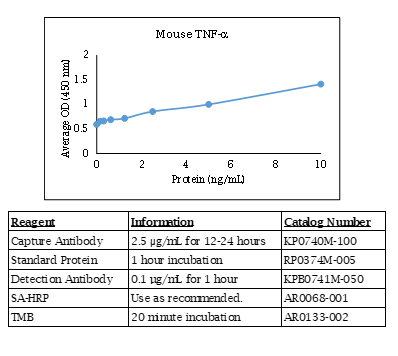
Mouse TNF alpha ELISA
- Catalog Number:
- DIY0745M
- Availability:
- In stock
- Application:
- ELISA
- 100% Homology:
- Mus musculus (house mouse)
 Powered by Bioz
 Components
| Usage | Quantity | Component | Size |
|---|---|---|---|
| Detection Antibody | 50 µg | KPB0741M-050 | |
| Standard | 5 µg | RP0374M-005 | |
| Capture Antibody | 100 µg | KP0740M-100 | 1 Pack (<= 10 Plates) |
| Capture Antibody | 100 µg X 2 | KP0740M-100 | 1 Pack (<= 20 Plates) |
- The Mouse TNF-α (Tumor Necrosis Factor Alpha) ELISA is designed for the quantitative measurement of mouse TNF-α in cell culture supernatants and can also be used to measure TNF-α in additional biological sample types reported in the literature, including serum, plasma, tissue lysates, and bronchoalveolar lavage fluid, supporting a wide range of immunology, inflammation, and translational research applications. TNF-α is a pro-inflammatory cytokine primarily produced by activated macrophages, monocytes, and T cells, and it plays a central role in innate immunity, inflammation, apoptosis, and the regulation of immune responses. In mouse models, TNF-α is widely studied in the context of infectious disease, sepsis, autoimmune disorders, vaccine response, and acute or chronic inflammation, where its expression reflects the magnitude and dynamics of inflammatory immune activation. Mice serve as a widely used animal model due to their genetic tractability, well-characterized immune system, and reproducibility, making them ideal for studying TNF-α-mediated pathways, disease mechanisms, and therapeutic interventions. Measurement of TNF-α provides valuable insight into inflammatory signaling, disease progression, and therapeutic efficacy. Reported measurements of mouse TNF-α have detected basal serum and plasma levels of approximately 5-50 pg/mL, with substantially elevated levels-often 200-1,000 pg/mL-following immune stimulation, infection, or inflammatory challenge, and measurable expression has also been observed in tissue lysates from inflamed or infected organs. The kit contains a capture antibody, detection antibody, and recombinant protein standard for assay development, and these antibodies have been validated to function together in an ELISA format using the provided standard. Optimal buffers, antibody concentrations, incubation times, temperatures, and assay conditions have not been predetermined, allowing researchers to optimize assay sensitivity and dynamic range based on their specific sample type and experimental requirements. The quantities of kit components are not matched, and individual components may be purchased separately. This product is for research use only and is manufactured in the USA.
| Storage Conditions | 2°C to 8°C or -20°C |
| Country Of Origin | USA |
Mouse Tumor Necrosis Factor Alpha (TNF-α) (also known as TNF or cachectin) is a proinflammatory cytokine that plays a central role in innate immune responses, inflammation, and host defense against pathogens in mice (Mus musculus). TNF-α is a member of the tumor necrosis factor (TNF) superfamily, which includes related cytokines such as TNF-β (lymphotoxin-α), Fas ligand (FasL), CD40 ligand (CD40L), and TRAIL, molecules that regulate immune signaling, apoptosis, and inflammatory processes. In mice, TNF-α is primarily produced by activated macrophages, monocytes, dendritic cells, and T lymphocytes in response to infection, endotoxin exposure, or tissue injury. TNF-α exerts its biological effects by binding to TNF receptors TNFR1 (p55) and TNFR2 (p75), activating intracellular signaling pathways including NF-κB, MAPK, and caspase-mediated pathways, which regulate cytokine production, immune cell activation, apoptosis, and inflammatory responses. Mouse TNF-α has been extensively studied in genetic knockout and transgenic models, which have demonstrated its critical role in host defense against pathogens, regulation of immune responses, and control of inflammation. Murine TNF signaling is particularly important in models of autoimmune disease, infectious disease, cancer, and inflammatory disorders, including collagen-induced arthritis (a model of rheumatoid arthritis), experimental autoimmune encephalomyelitis (a model of multiple sclerosis), and tuberculosis infection models. Because mice are the most widely used experimental organisms in immunology and biomedical research, characterization of mouse TNF-α has been fundamental for understanding cytokine-mediated inflammation and the development of TNF-targeted therapies used to treat human inflammatory diseases.
Citations
Please choose a size to see price
RELATED MEDIA
