Slide 1 of 1 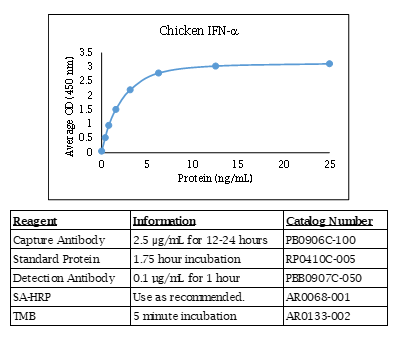
Chicken IFN alpha ELISA
- Catalog Number:
- DIY0908C
- Availability:
- In stock
- Application:
- ELISA
- 100% Homology:
- Gallus gallus (chicken)
 Powered by Bioz
 Components
| Usage | Quantity | Component | Size |
|---|---|---|---|
| Detection Antibody | 50 µg | PBB0907C-050 | |
| Standard | 5 µg | RP0410C-005 | |
| Capture Antibody | 100 µg | PB0906C-100 | 1 Pack (<= 10 Plates) |
| Capture Antibody | 100 µg X 2 | PB0906C-100 | 1 Pack (<= 20 Plates) |
- The Chicken IFN-α (Interferon Alpha) ELISA is designed for the quantitative measurement of IFN-α in cell culture supernatants from chickens and can also be used to measure IFN-α in additional biological sample types reported in the literature, including serum, plasma, and tissue lysates, supporting a wide range of immunology, antiviral, and translational research applications. IFN-α is a type I interferon primarily produced by plasmacytoid dendritic cells and other leukocytes, and it plays a central role in antiviral defense, innate immunity, and the activation of adaptive immune responses. In the chicken model, IFN-α is widely studied in the context of viral infections, vaccine responses, and immunotherapy, where its expression reflects the activation of antiviral signaling pathways and the host immune response. Measurement of IFN-α provides valuable insight into innate immune activation, viral pathogenesis, and the efficacy of immunomodulatory interventions. Reported measurements of chicken IFN-α have detected basal serum and plasma levels of approximately 25-200 pg/mL, with elevated levels-often 250-2,000 pg/mL-following viral infection, immune stimulation, or inflammatory challenge, and measurable expression has also been observed in tissue lysates from infected or immune-activated organs. The kit contains a capture antibody, detection antibody, and recombinant protein standard for assay development, and these antibodies have been validated to function together in an ELISA format using the provided standard. Optimal buffers, antibody concentrations, incubation times, temperatures, and assay conditions have not been predetermined, allowing researchers to optimize assay sensitivity and dynamic range based on their specific sample type and experimental requirements. The quantities of kit components are not matched, and individual components may be purchased separately. This product is for research use only and is manufactured in the USA.
| Storage Conditions | 2°C to 8°C or -20°C |
| Country Of Origin | USA |
Chicken Interferon-Alpha (IFN-α) is a type I interferon produced primarily by virus-infected cells and specialized immune cells in chickens (Gallus gallus), where it plays a central role in innate antiviral immunity. Upon binding to the avian type I interferon receptor complex (IFNAR1/IFNAR2), chicken IFN-α activates JAK/STAT signaling pathways, leading to induction of interferon-stimulated genes (ISGs) that inhibit viral replication, enhance antigen presentation, and promote activation of natural killer–like cells and adaptive immune responses. Chicken IFN-α is rapidly upregulated in response to economically significant viral infections such as avian influenza virus (AIV), Newcastle disease virus (NDV), infectious bronchitis virus (IBV), infectious bursal disease virus (IBDV), and Marek’s disease virus (MDV), where it contributes to early antiviral defense but may also influence immunopathology if dysregulated. As a key mediator and biomarker of antiviral responses, IFN-α is widely studied in poultry immunology for vaccine development, genetic selection for disease resistance, and evaluation of antiviral strategies. In research settings, chickens serve as important animal models for avian influenza pathogenesis, viral oncogenesis (Marek’s disease), and developmental immunology, and characterization of chicken IFN-α enhances understanding of host–virus interactions, innate immune regulation, and interferon-driven antiviral mechanisms relevant to both veterinary health and comparative immunology.
Citations
Please choose a size to see price
RELATED MEDIA
