Slide 1 of 1 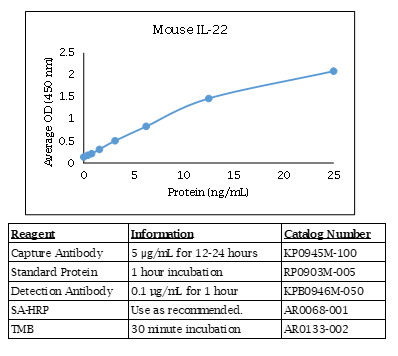
Mouse IL-22 ELISA
- Catalog Number:
- DIY0950M
- Availability:
- In stock
- Application:
- ELISA
- 100% Homology:
- Mus musculus (house mouse)
 Powered by Bioz
 Components
| Usage | Quantity | Component | Size |
|---|---|---|---|
| Detection Antibody | 50 µg | KPB0946M-050 | |
| Standard | 5 µg | RP0903M-005 | |
| Capture Antibody | 100 µg | KP0945M-100 | 1 Pack (<= 10 Plates) |
| Capture Antibody | 100 µg X 2 | KP0945M-100 | 1 Pack (<= 20 Plates) |
- The Mouse IL-22 (Interleukin-22) ELISA is designed for the quantitative measurement of IL-22 in cell culture supernatants from mice and can also be used to measure IL-22 in a wide variety of biological sample types reported in the literature, including serum, plasma, whole blood, cerebrospinal fluid, bronchoalveolar lavage fluid, and tissue lysates from organs such as liver, lung, spleen, kidney, and lymph nodes, supporting a broad range of immunology, inflammation, and translational research applications. IL-22 is a cytokine primarily produced by Th17 cells, innate lymphoid cells, and γδ T cells, and it plays a central role in maintaining epithelial barrier integrity, promoting antimicrobial defense, and regulating tissue inflammation. In the mouse model, IL-22 is widely studied in the context of autoimmune diseases, mucosal infections, and inflammatory disorders, where its expression reflects immune activation at epithelial surfaces and tissue-specific immune responses. Measurement of IL-22 provides valuable insight into immune regulation, barrier defense mechanisms, and the efficacy of immunomodulatory therapies. Reported measurements of mouse IL-22 have detected basal serum and plasma levels of approximately 20-250 pg/mL, with elevated levels-often 300-2,000 pg/mL-following immune stimulation, infection, or inflammatory challenge, and measurable expression has also been observed in tissue lysates from inflamed or immune-activated organs. The kit contains a capture antibody, detection antibody, and recombinant protein standard for assay development, and these antibodies have been validated to function together in an ELISA format using the provided standard. Optimal buffers, antibody concentrations, incubation times, temperatures, and assay conditions have not been predetermined, allowing researchers to optimize assay sensitivity and dynamic range based on their specific sample type and experimental requirements. The quantities of kit components are not matched, and individual components may be purchased separately. This product is for research use only and is manufactured in the USA.
| Storage Conditions | 2°C to 8°C or -20°C |
| Country Of Origin | USA |
Mouse IL-22 (Interleukin-22) is a member of the IL-10 cytokine family that plays a critical role in mucosal immunity and epithelial barrier protection in mice (Mus musculus). IL-22 is produced primarily by Th17 and Th22 CD4⁺ T cells, as well as by γδ T cells and innate lymphoid cells (ILC3s), in response to microbial infection and inflammatory stimulation. It signals through the IL-22 receptor complex (IL-22R1 and IL-10R2), which is expressed mainly on epithelial and stromal cells, activating downstream JAK/STAT pathways—particularly STAT3—to induce antimicrobial peptide production (e.g., RegIIIγ), enhance chemokine expression, promote epithelial cell proliferation, and support tissue repair. In healthy mice, basal IL-22 expression is generally low but increases during bacterial and fungal infections, especially at mucosal surfaces of the gastrointestinal and respiratory tracts. Mouse IL-22 has been extensively studied in models of colitis, inflammatory bowel disease, psoriasis-like dermatitis, bacterial pneumonia, and metabolic inflammation, where it can have protective or pathogenic roles depending on context. In biomedical research, mouse IL-22 serves as a key mediator of mucosal defense, epithelial regeneration, and host–pathogen interactions, and is widely used to investigate mechanisms of barrier immunity and inflammatory disease.
Citations
Please choose a size to see price
RELATED MEDIA
