Slide 1 of 1 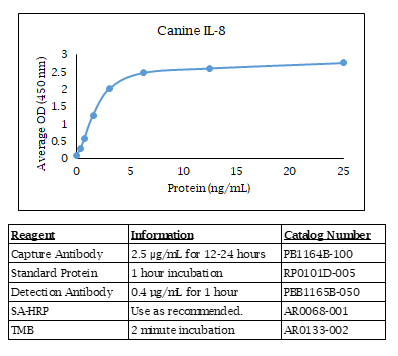
Canine IL-8 ELISA
- Catalog Number:
- DIY1166D
- Availability:
- In stock
- Application:
- ELISA
- 100% Homology:
- Canis lupus dingo (dingo), Canis lupus familiaris (dog), Nyctereutes procyonoides (raccoon dog), Vulpes lagopus (Arctic fox), Vulpes vulpes (red fox)
 Powered by Bioz
 Components
| Usage | Quantity | Component | Size |
|---|---|---|---|
| Detection Antibody | 50 µg | PBB1165B-050 | |
| Standard | 5 µg | RP0101D-005 | |
| Capture Antibody | 100 µg | PB1164B-100 | 1 Pack (<= 10 Plates) |
| Capture Antibody | 100 µg X 2 | PB1164B-100 | 1 Pack (<= 20 Plates) |
- The Canine IL-8 (Interleukin-8, also known as CXCL8) ELISA is designed for the quantitative measurement of IL-8 in cell culture supernatants from dogs and can also be used to measure IL-8 in a wide variety of biological sample types reported in the literature, including serum, plasma, whole blood, synovial fluid, bronchoalveolar lavage fluid, and tissue lysates from organs such as lung, spleen, liver, and lymph nodes. While the kit is optimized for cell culture supernatants, minor modifications to the protocol may be required when measuring IL-8 in other sample types to ensure optimal sensitivity and accuracy, allowing researchers to adjust buffers, antibody concentrations, incubation times, temperatures, and other assay conditions as needed. IL-8 is a chemokine primarily produced by monocytes, macrophages, epithelial cells, and endothelial cells, and it plays a central role in recruiting neutrophils to sites of infection or inflammation, coordinating innate immune responses, and regulating inflammatory signaling. In the canine animal model, IL-8 is widely studied in the context of bacterial and viral infections, inflammatory diseases, and immune-mediated conditions, where its expression reflects immune activation and leukocyte recruitment. Measurement of IL-8 provides valuable insight into immune system activation, disease progression, and the efficacy of immunomodulatory or therapeutic interventions. Reported measurements of canine IL-8 have detected basal serum and plasma levels of approximately 10-200 pg/mL, with elevated levels-often 250-1,500 pg/mL-following infection, immune stimulation, or inflammatory challenge, and measurable expression has also been observed in tissue lysates from inflamed or immune-activated organs. The kit contains a capture antibody, detection antibody, and recombinant protein standard for assay development, and these antibodies have been validated to function together in an ELISA format using the provided standard. The quantities of kit components are not matched, and individual components may be purchased separately. This product is for research use only and is manufactured in the USA.
| Storage Conditions | 2°C to 8°C or -20°C |
| Country Of Origin | USA |
Canine Interleukin-8 (IL-8), also known as CXCL8, is a potent pro-inflammatory chemokine that plays a central role in innate immune responses in dogs (Canis lupus familiaris) by mediating neutrophil chemotaxis, activation, and migration to sites of infection or tissue injury. Produced by macrophages, epithelial cells, endothelial cells, and fibroblasts in response to microbial stimuli and inflammatory cytokines, canine IL-8 signals primarily through CXCR1 and CXCR2 receptors to activate downstream pathways that promote leukocyte recruitment and amplification of acute inflammation. Elevated IL-8 expression is associated with a variety of canine diseases, including bacterial pneumonia, canine influenza, parvoviral enteritis, pyometra, atopic dermatitis, osteoarthritis, and inflammatory bowel disease, where excessive neutrophilic infiltration can contribute to tissue damage and chronic inflammation. As a biomarker, IL-8 is useful for assessing inflammatory status and monitoring therapeutic response in clinical veterinary medicine. Importantly, dogs serve as valuable spontaneous animal models for human diseases characterized by neutrophil-driven pathology, including asthma (canine chronic bronchitis), inflammatory bowel disease, atopic dermatitis, osteoarthritis, sepsis, and certain cancers such as osteosarcoma and lymphoma. Characterization of canine IL-8 in these naturally occurring models enhances translational research into chemokine-mediated immune cell trafficking, chronic inflammation, tumor microenvironment biology, and the development of targeted anti-inflammatory and immunomodulatory therapies relevant to both canine and human health.
Citations
Please choose a size to see price
RELATED MEDIA
