Slide 1 of 1 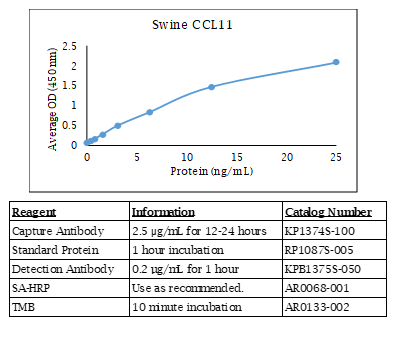
Swine CCL11 (Eotaxin-1) ELISA
- Catalog Number:
- DIY1376S
- Availability:
- In stock
- Application:
- ELISA
- 100% Homology:
- Sus scrofa (pig)
 Powered by Bioz
 Components
| Usage | Quantity | Component | Size |
|---|---|---|---|
| Detection Antibody | 50 µg | KPB1375S-050 | |
| Standard | 5 µg | RP1087S-005 | |
| Capture Antibody | 100 µg | KP1374S-100 | 1 Pack (<= 10 Plates) |
| Capture Antibody | 100 µg X 2 | KP1374S-100 | 1 Pack (<= 20 Plates) |
- The Swine CCL11 (Chemokine (C-C motif) ligand 11, also known as Eotaxin) ELISA is designed for the quantitative measurement of CCL11 in cell culture supernatants from pigs (Sus scrofa) and can also be used to measure CCL11 in a variety of biological sample types reported in the literature, including serum, plasma, whole blood, and tissue lysates from organs such as lung, spleen, liver, and lymph nodes. While the kit is optimized for cell culture supernatants, minor modifications to the protocol may be required when measuring CCL11 in other sample types to ensure optimal sensitivity and accuracy, allowing researchers to adjust buffers, antibody concentrations, incubation times, temperatures, and other assay conditions as needed. CCL11 is a chemokine primarily produced by activated eosinophils, epithelial cells, and endothelial cells and plays a central role in eosinophil recruitment, allergic inflammation, and host defense against parasitic infections. In the swine animal model, CCL11 is widely studied in the context of allergic disease, respiratory inflammation, parasitic infection, and immunomodulatory research, where its expression reflects chemokine-mediated immune activation and eosinophil trafficking. Measurement of CCL11 provides valuable insight into immune signaling, inflammatory responses, disease progression, and the efficacy of therapeutic interventions, with reported levels in pigs typically detected at low picogram-per-milliliter concentrations under basal conditions (~10-150 pg/mL in serum or plasma) and increasing during immune challenge, allergic reaction, or inflammatory stimulation, depending on sample type and experimental context. The kit contains a capture antibody, detection antibody, and recombinant swine CCL11 protein standard for assay development, and these antibodies have been validated to function together in an ELISA format using the provided standard. The quantities of kit components are not matched, and individual components may be purchased separately. This product is for research use only and is manufactured in the USA.
| Storage Conditions | 2°C to 8°C or -20°C |
| Country Of Origin | USA |
Swine CCL11 (C-C motif chemokine ligand 11), also known as eotaxin-1, is a member of the CC chemokine family that regulates eosinophil recruitment and type 2–associated immune responses in pigs (Sus scrofa). CCL11 is produced primarily by epithelial cells, fibroblasts, endothelial cells, smooth muscle cells, and activated immune cells in response to Th2-associated cytokines such as IL-4 and IL-13, as well as inflammatory stimuli. It functions predominantly through the CCR3 receptor to promote chemotaxis and activation of eosinophils, and can also influence basophils and certain Th2 lymphocytes. In healthy swine, basal CCL11 expression is generally low, but levels may increase during parasitic infections—particularly helminth infections affecting the gastrointestinal or respiratory tract—as well as during allergic-type inflammation and mucosal immune activation. In veterinary and translational research, swine CCL11 is of interest in studies of parasite immunity, airway inflammation, gut barrier function, and Th2-biased immune responses, particularly given the physiological similarities between pigs and humans. Characterizing CCL11 expression in swine provides valuable insight into eosinophil biology, chemokine-mediated leukocyte trafficking, and regulation of type 2 inflammatory responses in both agricultural and biomedical research settings.
Citations
Please choose a size to see price
RELATED MEDIA
