Slide 1 of 1 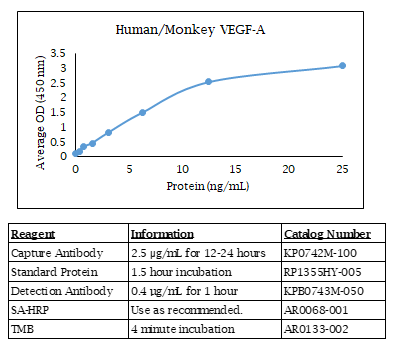
Multi-species (Human, Monkey) VEGF-A ELISA
- Catalog Number:
- DIY1444HY
- Availability:
- In stock
- Application:
- ELISA
- 100% Homology:
- Cercocebus atys (sooty mangabey), Chlorocebus sabaeus (green monkey), Colobus angolensis palliates (Peter’s Angolan Colobus), Gorilla gorilla gorilla (western lowland gorilla), Homo sapiens (human), Macaca fascicularis (crab-eating macaque), Macaca mulatta (Rhesus monkey), Macaca nemestrina (pig-tailed macaque), Mandrillus leucophaeus (drill), Nomascus leucogenys (northern white-cheeked gibbon), Pan paniscus (pygmy chimpanzee), Pan troglodytes (chimpanzee), Papio anubis (olive baboon), Rhinopithecus roxellana (golden snub-nosed monkey)
 Powered by Bioz
 - The Human and Monkey VEGF-A (Vascular Endothelial Growth Factor A) ELISA is designed for the quantitative measurement of VEGF-A in cell culture supernatants from humans and non-human primates and can also be used to measure VEGF-A in a broad range of biological sample types reported in the literature, including serum, plasma, whole blood, and tissue lysates from organs such as lung, kidney, liver, placenta, and tumor tissue. While the assay is optimized for cell culture supernatants, minor modifications to the protocol may be required for other sample types to ensure optimal sensitivity and accuracy, allowing adjustment of buffers, antibody concentrations, incubation times, and assay conditions as needed. VEGF-A is a central regulator of angiogenesis, vascular permeability, endothelial cell proliferation, and tissue remodeling, produced by endothelial cells, macrophages, fibroblasts, epithelial cells, and tumor cells in response to hypoxia and inflammatory stimuli. Due to the high sequence conservation of VEGF-A among primates, this assay is suitable for measuring VEGF-A from Cercocebus atys (sooty mangabey), Chlorocebus sabaeus (green monkey), Colobus angolensis palliatus (Peter's Angolan colobus), Gorilla gorilla gorilla (western lowland gorilla), Macaca mulatta (rhesus monkey), Macaca nemestrina (pig-tailed macaque), Mandrillus leucophaeus (drill), Nomascus leucogenys (northern white-cheeked gibbon), Pan paniscus (pygmy chimpanzee), Pan troglodytes (chimpanzee), Papio anubis (olive baboon), and Rhinopithecus roxellana (golden snub-nosed monkey), supporting its use across a wide range of non-human primate animal models. Measurement of VEGF-A provides critical insight into vascular biology, disease progression, angiogenic signaling, and therapeutic efficacy, with reported basal levels typically detected at low picogram-per-milliliter concentrations (~20-300 pg/mL in serum or plasma) and increasing during angiogenic stimulation, tissue injury, hypoxia, inflammation, or disease progression, depending on sample type and experimental context. The kit includes a capture antibody, detection antibody, and recombinant VEGF-A protein standard validated to function together in an ELISA format using the provided standard. The quantities of kit components are not matched, and individual components may be purchased separately. This product is for research use only and is manufactured in the USA.
| Storage Conditions | 2°C to 8°C or -20°C |
| Country Of Origin | USA |
Human and Cynomolgus Monkey Vascular Endothelial Growth Factor A (VEGF-A) is a member of the vascular endothelial growth factor (VEGF) family, which includes VEGF-A, VEGF-B, VEGF-C, VEGF-D, and placental growth factor (PlGF)—key regulators of angiogenesis, vascular permeability, and endothelial cell growth. In both humans (Homo sapiens) and cynomolgus monkeys (Macaca fascicularis), the VEGF-A protein is identical at the amino acid level, reflecting strong evolutionary conservation and similar biological functions in these primate species. VEGF-A is produced by many cell types including endothelial cells, macrophages, fibroblasts, epithelial cells, smooth muscle cells, and tumor cells, particularly in response to hypoxia, inflammation, and tissue injury. VEGF-A exerts its biological effects primarily through binding to VEGF receptor-1 (VEGFR-1/Flt-1) and VEGF receptor-2 (VEGFR-2/KDR) on endothelial cells, activating intracellular signaling pathways such as MAPK/ERK, PI3K/AKT, and PLCγ, which promote endothelial cell proliferation, migration, vascular permeability, and new blood vessel formation. In primates, VEGF-A plays essential roles in embryonic vascular development, wound healing, tissue regeneration, and reproductive physiology, including placental vascularization during pregnancy. Dysregulated VEGF-A expression is strongly associated with tumor angiogenesis, diabetic retinopathy, age-related macular degeneration, and other vascular diseases. Because cynomolgus monkeys are widely used as preclinical models for human vascular biology and therapeutic development, the identical VEGF-A sequence between these species supports their use in translational studies of angiogenesis and evaluation of anti-VEGF therapies such as monoclonal antibodies and receptor inhibitors used in cancer and ophthalmic diseases.
Citations
Please choose a size to see price
RELATED MEDIA
