Slide 1 of 1 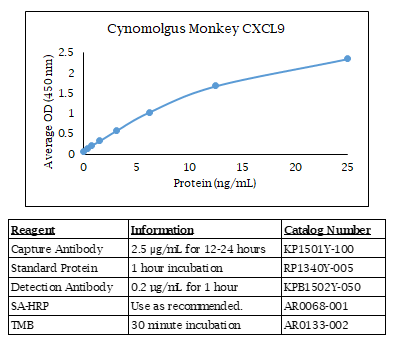
Cynomolgus Monkey CXCL9 (MIG) ELISA
- Catalog Number:
- DIY1503Y
- Availability:
- In stock
- Application:
- ELISA
- 100% Homology:
- Chlorocebus sabaeus (green monkey), Macaca fascicularis (crab-eating macaque), Macaca nemestrina (pig-tailed macaque), Mandrillus leucophaeus (drill), Theropithecus gelada (gelada)
 Powered by Bioz
 Components
| Usage | Quantity | Component | Size |
|---|---|---|---|
| Detection Antibody | 50 µg | KPB1502Y-050 | |
| Standard | 5 µg | RP1340Y-005 | |
| Capture Antibody | 100 µg | KP1501Y-100 | 1 Pack (<= 10 Plates) |
| Capture Antibody | 100 µg X 2 | KP1501Y-100 | 1 Pack (<= 20 Plates) |
- The Cynomolgus Monkey CXCL9 (MIG) ELISA is designed for the quantitative measurement of CXCL9 in cell culture supernatants from cynomolgus monkeys (Macaca fascicularis) and can also be used to measure CXCL9 in a variety of biological sample types reported in the literature, including serum, plasma, whole blood, and tissue lysates from organs such as lung, liver, spleen, lymph nodes, and inflamed tissues. While the assay is optimized for cell culture supernatants, minor modifications to the protocol may be required when measuring CXCL9 in other sample types to ensure optimal sensitivity and accuracy, allowing researchers to adjust buffers, antibody concentrations, incubation times, temperatures, and other assay conditions as needed. CXCL9 is an interferon-γ-inducible chemokine produced primarily by monocytes, macrophages, endothelial cells, and fibroblasts, and plays a central role in T cell recruitment, Th1-type immune responses, and inflammatory signaling. In the cynomolgus monkey animal model, CXCL9 is widely studied in the context of infectious disease, autoimmune inflammation, transplantation research, and immuno-oncology, where its expression reflects interferon-driven immune activation. The CXCL9 protein is conserved across several non-human primate species, including Chlorocebus sabaeus (green monkey), Macaca nemestrina (pig-tailed macaque), Mandrillus leucophaeus (drill), and Theropithecus gelada (gelada), supporting the use of this target in comparative and translational primate studies. Measurement of CXCL9 provides valuable insight into chemokine-mediated immune signaling, disease progression, and the evaluation of immunomodulatory or therapeutic interventions, with reported levels typically detected at low picogram-per-milliliter concentrations under basal conditions and increasing during immune activation or inflammatory challenge, depending on sample type and experimental context. The kit contains a capture antibody, detection antibody, and recombinant cynomolgus monkey CXCL9 protein standard for assay development, and these antibodies have been validated to function together in an ELISA format using the provided standard. The quantities of kit components are not matched, and individual components may be purchased separately. This product is for research use only and is manufactured in the USA.
| Storage Conditions | 2°C to 8°C or -20°C |
| Country Of Origin | USA |
Cynomolgus Monkey (Macaca fascicularis) CXCL9 (C-X-C motif chemokine ligand 9), also known as MIG (monokine induced by interferon-γ), is a proinflammatory chemokine belonging to the CXC chemokine family, which also includes CXCL10 (IP-10) and CXCL11 (I-TAC) that regulate T-cell recruitment during interferon-driven immune responses. In cynomolgus monkeys, CXCL9 is produced by macrophages, dendritic cells, endothelial cells, and epithelial cells in response to interferon-γ (IFN-γ) and inflammatory stimuli during infection or immune activation. CXCL9 signals primarily through the chemokine receptor CXCR3, which is expressed on activated T lymphocytes, natural killer (NK) cells, and other immune cells, promoting chemotaxis and accumulation of these cells at sites of infection or inflammation. Because cynomolgus monkeys share close genetic, immunological, and physiological similarities with humans, they are widely used as preclinical animal models for infectious diseases and immunological research. In these models, CXCL9 is part of the interferon-regulated chemokine network involved in antiviral immunity, including studies of SARS-CoV-2, dengue virus, and other viral infections, where CXCL9 contributes to CXCR3⁺ T-cell recruitment to infected tissues and regulation of inflammatory responses, making it an important marker of Th1-type immune activation in translational biomedical research.
Citations
Please choose a size to see price
RELATED MEDIA
