Slide 1 of 1 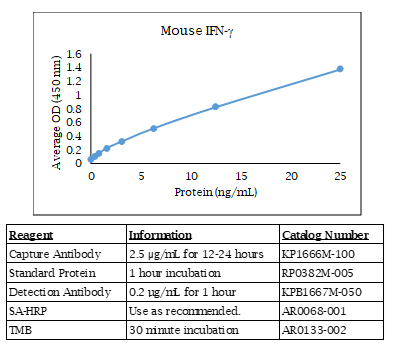
Mouse IFN gamma ELISA
- Catalog Number:
- DIY1668M
- Availability:
- In stock
- Application:
- ELISA
- 100% Homology:
- Mus musculus (house mouse)
 Powered by Bioz
 Components
| Usage | Quantity | Component | Size |
|---|---|---|---|
| Detection Antibody | 50 µg | KPB1667M-050 | |
| Standard | 5 µg | RP0382M-005 | |
| Capture Antibody | 100 µg | KP1666M-100 | 1 Pack (<= 10 Plates) |
| Capture Antibody | 100 µg X 2 | KP1666M-100 | 1 Pack (<= 20 Plates) |
- The Mouse IFN-γ ELISA is designed for the quantitative measurement of interferon-gamma (IFN-γ) in cell culture supernatants from mice (Mus musculus) and can also be applied to other sample types reported in the literature, including serum, plasma, splenocyte or peripheral blood leukocyte culture supernatants, and tissue lysates, with minor protocol modifications to optimize assay performance in different matrices. IFN-γ is a key Th1-type cytokine produced primarily by activated T cells, NK cells, and NKT cells in response to antigenic, mitogenic, or inflammatory stimuli, and it plays a central role in innate and adaptive immunity by activating macrophages, enhancing antigen presentation, promoting cytotoxic T cell responses, and orchestrating antiviral, antibacterial, and antitumor defenses. In murine models, IFN-γ is widely used as a biomarker for cellular immune activation, vaccine efficacy, pathogen challenge responses, and immunotherapeutic studies. Measurement of mouse IFN-γ provides valuable insight into host-pathogen interactions, Th1/Th2 immune balance, and immune-modulatory effects of experimental treatments, with basal concentrations typically low and increasing substantially following infection, immunization, or cytokine stimulation, depending on tissue source and experimental context. IFN-γ is particularly relevant in studies of viral infections such as influenza and lymphocytic choriomeningitis virus (LCMV), bacterial infections including Mycobacterium tuberculosis and Listeria monocytogenes, and autoimmune disease models like experimental autoimmune encephalomyelitis (EAE) and type 1 diabetes. The ELISA kit contains a capture antibody, detection antibody, and recombinant mouse IFN-γ protein standard validated to function together in an optimized ELISA format. Kit components are not provided in matched quantities and may be purchased separately. This product is for research use only and is manufactured in the USA.
| Storage Conditions | 2°C to 8°C or -20°C |
| Country Of Origin | USA |
Mouse Interferon-γ (IFN-γ) is a type II interferon cytokine that plays a central role in cell-mediated immunity and regulation of antimicrobial and inflammatory responses in mice (Mus musculus). IFN-γ is produced primarily by activated T helper 1 (Th1) cells, cytotoxic T lymphocytes, and natural killer (NK) cells following stimulation by intracellular pathogens or immune signaling molecules such as IL-12 and IL-18. Mouse IFN-γ binds to the interferon-γ receptor (IFNGR1/IFNGR2) expressed on many immune and non-immune cells, activating intracellular signaling through the JAK–STAT pathway, particularly STAT1, which induces expression of numerous interferon-stimulated genes involved in antigen presentation, macrophage activation, and antimicrobial defense. In mice, IFN-γ is critical for activation of macrophages, enhancement of MHC class I and II expression, and control of intracellular pathogens, including mycobacteria, viruses, and certain parasites, and it is widely studied in murine models of infectious disease, cancer, and immunology to investigate immune regulation, host–pathogen interactions, and therapeutic strategies.
Citations
Please choose a size to see price
RELATED MEDIA
