Slide 1 of 1 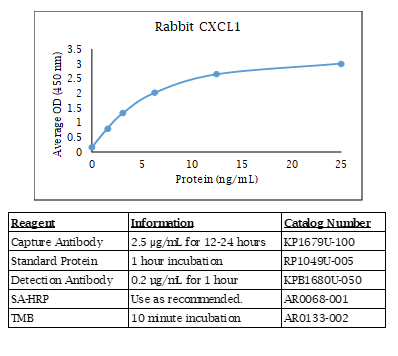
Rabbit CXCL1 (GRO alpha) ELISA
- Catalog Number:
- DIY1681U
- Availability:
- In stock
- Application:
- ELISA
- 100% Homology:
- Oryctolagus cuniculus (rabbit)
 Powered by Bioz
 Components
| Usage | Quantity | Component | Size |
|---|---|---|---|
| Detection Antibody | 50 µg | KPB1680U-050 | |
| Standard | 5 µg | RP1049U-005 | |
| Capture Antibody | 100 µg | KP1679U-100 | 1 Pack (<= 10 Plates) |
| Capture Antibody | 100 µg X 2 | KP1679U-100 | 1 Pack (<= 20 Plates) |
- The Rabbit CXCL1 ELISA is designed for the quantitative measurement of CXCL1 in cell culture supernatants from rabbits (Oryctolagus cuniculus) and can also be used to measure CXCL1 in additional biological sample types reported in the literature, including serum, plasma, bronchoalveolar lavage fluid, and tissue lysates, with minor protocol modifications recommended to optimize assay performance across different matrices. CXCL1 is a pro-inflammatory CXC chemokine produced by macrophages, epithelial cells, endothelial cells, fibroblasts, and other cell types in response to inflammatory cytokines, microbial components, and tissue injury, and it functions primarily through the CXCR2 receptor to mediate neutrophil chemotaxis, activation, and recruitment to sites of inflammation. In rabbit models, CXCL1 serves as an important biomarker of acute inflammatory responses and innate immune activation, particularly in studies of respiratory disease, wound healing, gastrointestinal inflammation, and bacterial infection. Measurement of rabbit CXCL1 provides insight into neutrophil-driven inflammatory pathways, host-pathogen interactions, and tissue-specific immune responses, with basal concentrations typically low and increasing significantly following infection, immune stimulation, or inflammatory challenge depending on the experimental context. The ELISA kit contains a capture antibody, detection antibody, and recombinant rabbit CXCL1 protein standard validated for use together in an ELISA format; kit components are not supplied in matched quantities and may be purchased separately. This product is for research use only and is manufactured in the USA.
| Storage Conditions | 2°C to 8°C or -20°C |
| Country Of Origin | USA |
Rabbit CXCL1 (C-X-C motif chemokine ligand 1, also known as GRO-α – growth-regulated oncogene alpha) is a proinflammatory chemokine belonging to the CXC chemokine family, which includes related chemokines such as CXCL2, CXCL3, and CXCL8 (IL-8) that regulate neutrophil recruitment during inflammatory responses. In rabbits (Oryctolagus cuniculus), CXCL1 is produced by macrophages, epithelial cells, endothelial cells, and fibroblasts in response to infection, inflammatory cytokines, or tissue injury. CXCL1 primarily signals through the chemokine receptor CXCR2, promoting chemotaxis, activation, and migration of neutrophils and other innate immune cells to sites of infection or inflammation. In rabbit physiology, CXCL1 contributes to innate immune defense and inflammatory responses, particularly in tissues such as the lungs, skin, and vascular endothelium. Rabbits are widely used as animal models for inflammatory and cardiovascular diseases, including atherosclerosis, where CXCL1-mediated recruitment of neutrophils and other leukocytes to vascular tissues contributes to vascular inflammation and plaque development. Consequently, rabbit CXCL1 is studied in immunology, vascular biology, and host–pathogen interaction research to better understand chemokine-driven leukocyte recruitment and inflammatory disease mechanisms.
Citations
Please choose a size to see price
RELATED MEDIA
