Slide 1 of 1 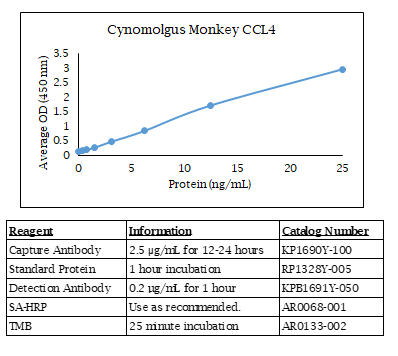
Cynomolgus Monkey CCL4 (MIP-1 beta) ELISA
- Catalog Number:
- DIY1692Y
- Availability:
- In stock
- Application:
- ELISA
- 100% Homology:
- Macaca fascicularis (crab-eating macaque), Macaca mulatta (Rhesus monkey), Rhinopithecus roxellana (golden snub-nosed monkey)
 Powered by Bioz
 Components
| Usage | Quantity | Component | Size |
|---|---|---|---|
| Detection Antibody | 50 µg | KPB1691Y-050 | |
| Standard | 5 µg | RP1328Y-005 | |
| Capture Antibody | 100 µg | KP1690Y-100 | 1 Pack (<= 10 Plates) |
| Capture Antibody | 100 µg X 2 | KP1690Y-100 | 1 Pack (<= 20 Plates) |
- The Cynomolgus Monkey CCL4 (MIP-1β) ELISA is designed for the quantitative measurement of CCL4 in cell culture supernatants from Cynomolgus monkeys (Macaca fascicularis) and can also be applied to additional biological sample types reported in the literature, including serum, plasma, peripheral blood mononuclear cell (PBMC) culture supernatants, and tissue lysates, with minor protocol modifications recommended to optimize assay performance across different matrices. CCL4 is a CC chemokine produced by activated T lymphocytes, monocytes, macrophages, dendritic cells, and other immune cells in response to inflammatory stimuli, viral infection, and immune activation, and it functions primarily through the CCR5 receptor to recruit and activate monocytes, NK cells, and T cells at sites of infection or tissue inflammation. In non-human primate models, CCL4 is widely used as a biomarker of cellular immune activation, antiviral responses, and cytokine release, particularly in studies of viral pathogenesis, vaccine development, immune modulation, and biologic safety assessment. Measurement of Cynomolgus monkey CCL4 provides insight into chemokine-driven leukocyte trafficking, Th1-type immune responses, and host-pathogen interactions, with basal concentrations typically low and increasing following infection, antigen stimulation, or inflammatory challenge depending on experimental design and sample source. The ELISA kit contains a capture antibody, detection antibody, and recombinant Cynomolgus monkey CCL4 protein standard validated to function together in an ELISA format; kit components are not supplied in matched quantities and may be purchased separately. This product is for research use only and is manufactured in the USA.
| Storage Conditions | 2°C to 8°C or -20°C |
| Country Of Origin | USA |
Cynomolgus Monkey (Macaca fascicularis) CCL4 (C-C motif chemokine ligand 4, also known as MIP-1β, macrophage inflammatory protein-1 beta) is a pro-inflammatory chemokine that regulates recruitment and activation of immune cells during inflammatory and antiviral immune responses in nonhuman primates. CCL4 primarily signals through the CCR5 receptor, promoting chemotaxis of monocytes, macrophages, dendritic cells, natural killer (NK) cells, and activated T lymphocytes to sites of infection or tissue injury. In cynomolgus monkeys, CCL4 is produced by activated macrophages, dendritic cells, epithelial cells, and lymphocytes in response to inflammatory stimuli such as pathogen-associated molecules and cytokines including TNF-α and IL-1β. Because cynomolgus monkeys are widely used in preclinical infectious disease and immunology research, CCL4 is frequently studied in models of viral infections such as dengue, influenza, HIV/SIV, and SARS-CoV-2, where chemokine-mediated recruitment of immune cells contributes to antiviral defense and inflammatory responses. CCL4 signaling through CCR5 also influences immune cell trafficking and immune activation during vaccine responses and therapeutic evaluation. As a regulator of leukocyte migration and inflammatory signaling, cynomolgus monkey CCL4 provides an important translational model for understanding chemokine-mediated immune responses, host–pathogen interactions, and immunomodulatory therapies relevant to human disease.
Citations
Please choose a size to see price
RELATED MEDIA
