Slide 1 of 1 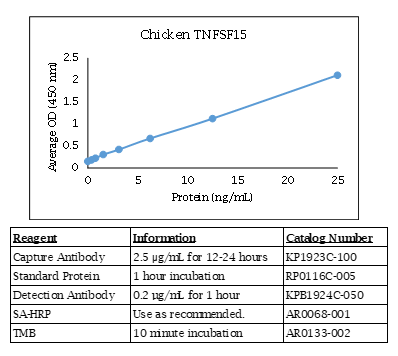
Chicken TNFSF15 ELISA
- Catalog Number:
- DIY1925C
- Availability:
- In stock
- Application:
- ELISA
- 100% Homology:
- Gallus gallus (chicken)
 Powered by Bioz
 Components
| Usage | Quantity | Component | Size |
|---|---|---|---|
| Detection Antibody | 50 µg | KPB1924C-050 | |
| Standard | 5 µg | RP0116C-005 | |
| Capture Antibody | 100 µg | KP1923C-100 | 1 Pack (<= 10 Plates) |
| Capture Antibody | 100 µg X 2 | KP1923C-100 | 1 Pack (<= 20 Plates) |
- The Chicken TNFSF15 (Tumor Necrosis Factor Superfamily Member 15, also known as TL1A) ELISA is designed for the quantitative measurement of TNFSF15 in chicken (Gallus gallus) cell culture supernatants and can also be used to measure TNFSF15 in additional biological sample types reported in the literature, including serum, plasma, intestinal lavage fluid, and tissue lysates, with minor protocol modifications recommended to optimize performance across different matrices. TNFSF15 is a pro-inflammatory cytokine belonging to the TNF superfamily and is primarily produced by activated antigen-presenting cells, macrophages, dendritic cells, and endothelial cells, where it functions through death receptor 3 (DR3) to promote T cell activation, Th1 and Th17 responses, cytokine production, and inflammatory signaling. In poultry, TNFSF15 plays an important role in mucosal immunity, intestinal inflammation, and host defense against enteric pathogens. In healthy chickens, circulating TNFSF15 levels are typically low or near the limit of detection, but concentrations can increase during coccidial infection (e.g., Eimeria spp.), necrotic enteritis (Clostridium perfringens), avian influenza virus infection, Salmonella challenge, and other inflammatory or vaccine-induced immune responses, depending on disease severity and immune status. In avian immunology and poultry health research, chicken TNFSF15 serves as an important biomarker of T cell-mediated immunity, intestinal inflammatory responses, and vaccine efficacy in production and experimental models. The ELISA kit contains a capture antibody, detection antibody, and recombinant chicken TNFSF15 protein standard validated for use together in an ELISA format; kit components are not supplied in matched quantities and may be purchased separately. This product is for research use only, not for use in diagnostic or therapeutic procedures, and is manufactured in the USA.
| Storage Conditions | 2°C to 8°C or -20°C |
| Country Of Origin | USA |
Chicken TNFSF15 (Tumor Necrosis Factor Superfamily Member 15, also known as TL1A or VEGI—vascular endothelial growth inhibitor) is a cytokine belonging to the tumor necrosis factor (TNF) superfamily, which includes related ligands such as TNF-α, Fas ligand (FasL), CD40 ligand (CD40L), TRAIL, and RANKL that regulate immune signaling, apoptosis, and inflammatory responses. In chickens (Gallus gallus), TNFSF15 is primarily produced by endothelial cells, macrophages, dendritic cells, and other immune cells following infection or inflammatory stimulation. TNFSF15 exerts its biological effects mainly through binding to death receptor 3 (DR3, TNFRSF25) on T lymphocytes and other immune cells, activating intracellular signaling pathways including NF-κB and MAPK, which regulate T cell activation, cytokine production, and inflammatory responses. In chickens, TNFSF15 is also associated with regulation of vascular endothelial cell growth and angiogenesis, reflecting its alternative designation as VEGI. The cytokine contributes to immune responses against bacterial and viral pathogens, and it may influence T cell–mediated immunity and inflammatory regulation in avian species. Because chickens serve as important models for avian immunology and host–pathogen interactions, characterization of chicken TNFSF15 supports research on immune regulation, cytokine signaling, and inflammatory responses relevant to poultry health and disease resistance.
Citations
Please choose a size to see price
RELATED MEDIA
