Slide 1 of 1 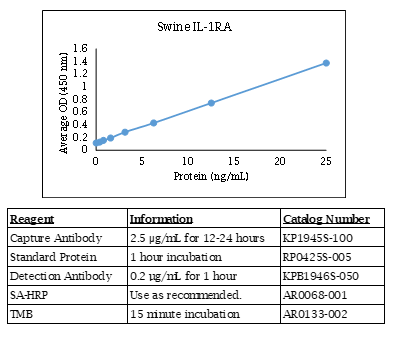
Swine Receptor Antagonist (IL-1RA) ELISA
- Catalog Number:
- DIY1947S
- Availability:
- In stock
- Application:
- ELISA
- 100% Homology:
- Sus scrofa (pig)
 Powered by Bioz
 Components
| Usage | Quantity | Component | Size |
|---|---|---|---|
| Detection Antibody | 50 µg | KPB1946S-050 | |
| Standard | 5 µg | RP0425S-005 | |
| Capture Antibody | 100 µg | KP1945S-100 | 1 Pack (<= 10 Plates) |
| Capture Antibody | 100 µg X 2 | KP1945S-100 | 1 Pack (<= 20 Plates) |
- The Swine IL-1ra (Interleukin-1 Receptor Antagonist) ELISA is designed for the quantitative measurement of IL-1ra in porcine (swine) cell culture supernatants and can also be used to measure IL-1ra in additional biological sample types reported in the literature, including serum, plasma, bronchoalveolar lavage (BAL) fluid, synovial fluid, and tissue lysates, with minor protocol modifications recommended to optimize performance across different matrices. IL-1ra is a naturally occurring anti-inflammatory cytokine produced primarily by monocytes, macrophages, neutrophils, and epithelial cells, and it functions by competitively binding to the IL-1 receptor (IL-1R1) without inducing signaling, thereby inhibiting the pro-inflammatory effects of IL-1α and IL-1β and regulating inflammatory responses. In healthy swine, circulating IL-1ra levels are typically low to moderate (often in the tens to low hundreds of pg/mL in serum or plasma), reflecting its role in maintaining immune homeostasis, but concentrations may increase substantially during acute infection, endotoxemia, respiratory disease, enteric inflammation, joint inflammation, or experimental immune stimulation, depending on disease severity and timing of sampling. In veterinary and translational research, swine IL-1ra serves as an important biomarker of anti-inflammatory counter-regulation, cytokine balance, systemic inflammatory responses, and therapeutic modulation in porcine models of infectious disease, sepsis, and inflammatory disorders. The ELISA kit contains a capture antibody, detection antibody, and recombinant swine IL-1ra protein standard validated for use together in an ELISA format; kit components are not supplied in matched quantities and may be purchased separately. This product is for research use only, not for use in diagnostic or therapeutic procedures, and is manufactured in the USA.
| Storage Conditions | 2°C to 8°C or -20°C |
| Country Of Origin | USA |
Swine Interleukin-1 Receptor Antagonist (IL-1Ra) is an anti-inflammatory cytokine produced by monocytes, macrophages, neutrophils, and other immune cells in pigs (Sus scrofa domesticus) that serves as a key endogenous regulator of IL-1–mediated inflammatory responses. IL-1Ra competitively binds to the IL-1 receptor type 1 (IL-1R1) without initiating intracellular signaling, thereby blocking the pro-inflammatory effects of IL-1α and IL-1β and limiting activation of NF-κB and MAPK pathways that drive fever, leukocyte recruitment, endothelial activation, and acute-phase responses. In swine health, IL-1Ra plays an important role in modulating inflammation associated with economically significant diseases such as porcine reproductive and respiratory syndrome (PRRS), swine influenza, African swine fever, bacterial pneumonia, enteric infections, and sepsis, where balancing IL-1 activity is critical to reducing tissue damage while maintaining pathogen clearance. The IL-1/IL-1Ra ratio can influence disease severity, lung pathology, and growth performance. As a biomarker of anti-inflammatory regulation, swine IL-1Ra is valuable in vaccine evaluation and immune modulation studies. In translational research, pigs serve as important large-animal models for human sepsis, trauma, and inflammatory disorders due to physiological similarities to humans, and characterization of swine IL-1Ra supports investigations into inflammasome regulation, cytokine network balance, and development of IL-1–targeted therapeutic strategies relevant to both veterinary and human medicine.
Citations
Please choose a size to see price
RELATED MEDIA
