Slide 1 of 1 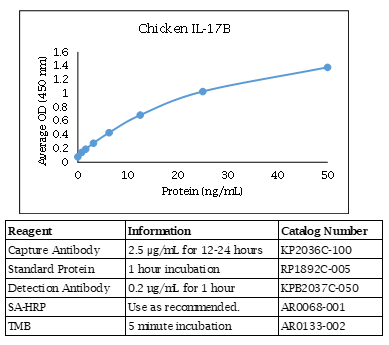
Chicken IL-17B (IL-20) ELISA
- Catalog Number:
- DIY2038C
- Availability:
- In stock
- Application:
- ELISA
- 100% Homology:
- Gallus gallus (chicken)
 Powered by Bioz
 Components
| Usage | Quantity | Component | Size |
|---|---|---|---|
| Detection Antibody | 50 µg | KPB2037C-050 | |
| Standard | 5 µg | RP1892C-005 | |
| Capture Antibody | 100 µg | KP2036C-100 | 1 Pack (<= 10 Plates) |
| Capture Antibody | 100 µg X 2 | KP2036C-100 | 1 Pack (<= 20 Plates) |
- The Chicken IL-17B (Interleukin-17B, also known as IL17B and IL-20 subfamily member B) ELISA is designed for the quantitative measurement of IL-17B in chicken (Gallus gallus) cell culture supernatants and can also be used to measure IL-17B in additional biological sample types reported in the literature, including serum, plasma, intestinal lavage fluid, and tissue lysates, with minor protocol modifications recommended to optimize performance across different matrices. IL-17B is a member of the IL-17 cytokine family and is produced by epithelial cells, macrophages, and other immune cell populations, where it contributes to pro-inflammatory signaling and regulation of mucosal immunity. IL-17B signals primarily through the IL-17RB receptor and is involved in coordinating inflammatory responses, chemokine production, and leukocyte recruitment, particularly at barrier surfaces such as the gastrointestinal and respiratory tracts. In healthy chickens, circulating IL-17B levels are typically low or near the limit of detection, but concentrations may increase during enteric infections (e.g., Eimeria spp. coccidiosis, Clostridium perfringens-associated necrotic enteritis), respiratory infections, Salmonella challenge, or vaccine-induced immune activation, depending on disease severity and immune status. Measurement of chicken IL-17B provides valuable insight into mucosal immune activation, inflammatory signaling pathways, host-pathogen interactions, and immune modulation in poultry health and avian disease research. The ELISA kit contains a capture antibody, detection antibody, and recombinant chicken IL-17B protein standard validated for use together in an ELISA format; kit components are not supplied in matched quantities and may be purchased separately. This product is for research use only, not for use in diagnostic or therapeutic procedures, and is manufactured in the USA.
| Storage Conditions | 2°C to 8°C or -20°C |
| Country Of Origin | USA |
Chicken IL-17B (Interleukin-17B) is a member of the IL-17 cytokine family that contributes to regulation of inflammatory and immune responses in chickens (Gallus gallus). IL-17B is expressed by a variety of cell types, including epithelial cells and immune cells, particularly in response to microbial infection or inflammatory stimulation. Although less characterized than IL-17A, IL-17B is believed to signal through the IL-17RB receptor to modulate production of pro-inflammatory cytokines and chemokines, thereby influencing heterophil recruitment and mucosal immune responses. In healthy chickens, basal IL-17B expression is generally low but can increase during bacterial, viral, or parasitic infections, as well as following vaccination or immune challenge. In poultry immunology research, chicken IL-17B is of interest for its role in regulating mucosal inflammation, host defense in the respiratory and gastrointestinal tracts, and modulation of Th17-associated pathways. Characterization of IL-17B in chickens provides insight into avian inflammatory signaling networks and immune regulation relevant to disease resistance and vaccine development in commercial poultry systems.
Citations
Please choose a size to see price
RELATED MEDIA
