Slide 1 of 1 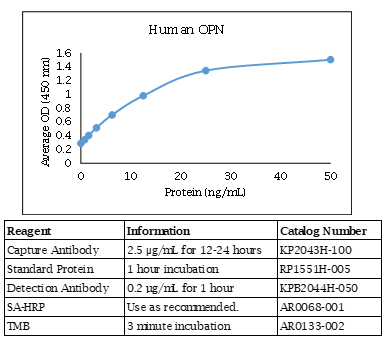
Human Osteopontin (OPN) ELISA
- Catalog Number:
- DIY2045H
- Availability:
- In stock
- Application:
- ELISA
- 100% Homology:
- Homo sapiens (human)
 Powered by Bioz
 Components
| Usage | Quantity | Component | Size |
|---|---|---|---|
| Detection Antibody | 50 µg | KPB2044H-050 | |
| Standard | 5 µg | RP1551H-005 | |
| Capture Antibody | 100 µg | KP2043H-100 | 1 Pack (<= 10 Plates) |
| Capture Antibody | 100 µg X 2 | KP2043H-100 | 1 Pack (<= 20 Plates) |
- The Human OPN (Osteopontin, also known as Secreted Phosphoprotein 1 [SPP1]) ELISA is designed for the quantitative measurement of osteopontin in human cell culture supernatants and can also be used to measure OPN in additional biological sample types reported in the literature, including serum, plasma, urine, cerebrospinal fluid (CSF), bronchoalveolar lavage (BAL) fluid, and tissue lysates, with minor protocol modifications recommended to optimize performance across different matrices. Osteopontin is a multifunctional secreted glycoprotein produced by osteoblasts, macrophages, activated T cells, endothelial cells, epithelial cells, and tumor cells, and it functions as both an extracellular matrix protein and cytokine, interacting with integrins and CD44 receptors to regulate cell adhesion, migration, survival, and inflammatory signaling. OPN plays critical roles in bone remodeling, wound healing, immune cell recruitment, Th1 and Th17 immune responses, fibrosis, and tumor progression. In healthy individuals, circulating OPN levels are typically present at measurable baseline concentrations (often in the low to mid ng/mL range in plasma or serum), but levels can increase significantly in inflammatory diseases, autoimmune disorders, cardiovascular disease, chronic kidney disease, fibrosis, and various malignancies, depending on disease activity and tissue involvement. Measurement of human OPN provides valuable insight into inflammatory burden, immune activation, tissue remodeling, fibrosis, and cancer progression in clinical and translational research settings. The ELISA kit contains a capture antibody, detection antibody, and recombinant human OPN protein standard validated for use together in an ELISA format; kit components are not supplied in matched quantities and may be purchased separately. This product is for research use only, not for use in diagnostic or therapeutic procedures, and is manufactured in the USA.
| Storage Conditions | 2°C to 8°C or -20°C |
| Country Of Origin | USA |
Human Osteopontin (OPN) (also known as SPP1, Secreted Phosphoprotein 1, bone sialoprotein I, ETA-1, or early T-lymphocyte activation-1) is a multifunctional phosphorylated glycoprotein involved in immune regulation, cell adhesion, and tissue remodeling. Osteopontin interacts with integrins (such as αvβ3, αvβ1, and α4β1) and CD44 receptors, activating signaling pathways that regulate cell migration, inflammatory responses, and extracellular matrix remodeling. In humans, OPN is produced by osteoblasts, macrophages, dendritic cells, epithelial cells, and activated T lymphocytes, and plays key roles in bone remodeling, immune activation, and tissue repair. OPN is also an important mediator of inflammatory and immune-mediated diseases, including rheumatoid arthritis, multiple sclerosis, inflammatory bowel disease, and atherosclerosis, where it contributes to leukocyte recruitment and cytokine signaling. In addition, osteopontin is strongly implicated in fibrosis and cancer, influencing tumor progression, angiogenesis, and immune cell infiltration in cancers such as breast, lung, and colorectal cancer. Because of its involvement in immune regulation, inflammation, and extracellular matrix remodeling, human osteopontin is widely studied as both a biomarker and therapeutic target in inflammatory diseases, fibrotic disorders, and oncology.
Citations
Please choose a size to see price