Slide 1 of 1 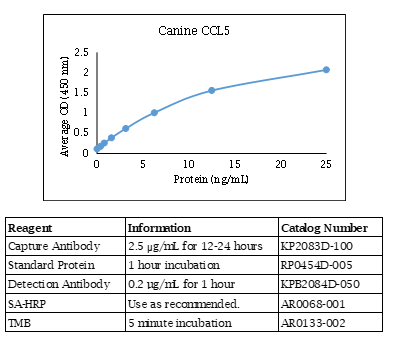
Canine CCL5 (RANTES) ELISA
- Catalog Number:
- DIY2085D
- Availability:
- In stock
- Application:
- ELISA
- 100% Homology:
- Canis lupus dingo (dingo), Canis lupus familiaris (dog)
 Powered by Bioz
 Components
| Usage | Quantity | Component | Size |
|---|---|---|---|
| Detection Antibody | 50 µg | KPB2084D-050 | |
| Standard | 5 µg | RP0454D-005 | |
| Capture Antibody | 100 µg | KP2083D-100 | 1 Pack (<= 10 Plates) |
| Capture Antibody | 100 µg X 2 | KP2083D-100 | 1 Pack (<= 20 Plates) |
- The Canine CCL5 (C-C motif chemokine ligand 5, also known as RANTES) ELISA is designed for the quantitative measurement of CCL5 in dog (Canis lupus familiaris) cell culture supernatants and can also be used to measure CCL5 in additional biological sample types reported in the literature, including serum, plasma, bronchoalveolar lavage (BAL) fluid, synovial fluid, and tissue lysates, with minor protocol modifications recommended to optimize performance across different matrices. CCL5 is a pro-inflammatory CC chemokine produced primarily by activated T lymphocytes, macrophages, platelets, epithelial cells, and endothelial cells in response to viral infection and inflammatory cytokines, and it functions through chemokine receptors such as CCR1, CCR3, and CCR5 to recruit T cells, monocytes, eosinophils, and NK cells to sites of inflammation. In healthy dogs, circulating CCL5 levels are typically low or near the limit of detection, but concentrations can increase during inflammatory and immune-mediated diseases such as atopic dermatitis, inflammatory bowel disease (IBD), chronic bronchitis, immune-mediated hemolytic anemia (IMHA), immune-mediated polyarthritis (IMPA), and autoimmune disorders, as well as during infectious diseases including canine distemper virus, parvovirus infection, ehrlichiosis, and leishmaniasis. In addition, canine CCL5 is relevant in translational and comparative medicine models, including spontaneous osteoarthritis, dilated cardiomyopathy, melanoma, lymphoma, mammary carcinoma, and other naturally occurring cancers that serve as models for human disease, as well as allergic airway disease and autoimmune conditions studied for immunotherapy development. Measurement of canine CCL5 provides valuable insight into leukocyte recruitment, T cell trafficking, immune-mediated inflammation, tumor-associated immune responses, and disease progression in both veterinary and translational research settings. The ELISA kit contains a capture antibody, detection antibody, and recombinant canine CCL5 protein standard validated for use together in an ELISA format; kit components are not supplied in matched quantities and may be purchased separately. This product is for research use only, not for use in diagnostic or therapeutic procedures, and is manufactured in the USA.
| Storage Conditions | 2°C to 8°C or -20°C |
| Country Of Origin | USA |
Canine CCL5 (C–C motif chemokine ligand 5, also known as RANTES – Regulated upon Activation, Normal T cell Expressed and Secreted) is a proinflammatory chemokine that regulates immune cell recruitment, inflammatory signaling, and antiviral responses in dogs (Canis lupus familiaris). CCL5 belongs to the CC chemokine family, which also includes CCL3 (MIP-1α), CCL4 (MIP-1β), and CCL2 (MCP-1), chemokines that control leukocyte trafficking during immune activation. In dogs, CCL5 is produced primarily by activated T lymphocytes, macrophages, dendritic cells, platelets, and epithelial cells in response to infection, inflammatory stimuli, or tissue injury, and exerts its biological effects mainly through binding to the chemokine receptors CCR1, CCR3, and CCR5, promoting chemotaxis and activation of T cells, monocytes/macrophages, eosinophils, and natural killer (NK) cells at sites of inflammation. CCL5 contributes to immune responses against viral and bacterial pathogens and is involved in chronic inflammatory and immune-mediated diseases such as canine atopic dermatitis and inflammatory bowel disease. Because dogs naturally develop several diseases that resemble human conditions, including allergic skin disease, inflammatory bowel disease, and certain cancers, canine CCL5 is also studied in comparative animal models of human inflammatory and immune-mediated disorders, helping to understand chemokine-driven leukocyte recruitment, tumor microenvironment signaling, and therapeutic targeting of the CCL5–CCR5 pathway.
Citations
Please choose a size to see price