Slide 1 of 1 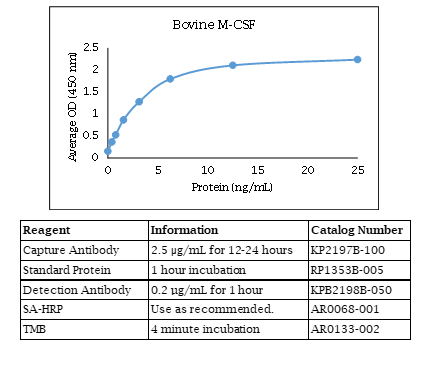
Bovine M-CSF ELISA
- Catalog Number:
- DIY2199B
- Availability:
- In stock
- Application:
- ELISA
- 100% Homology:
- Bison bison bison (American buffalo), Bos indicus (zebu), Bos mutus (wild yak), Bos taurus (cattle)
 Powered by Bioz
 Components
| Usage | Quantity | Component | Size |
|---|---|---|---|
| Detection Antibody | 50 µg | KPB2198B-050 | |
| Standard | 5 µg | RP1353B-005 | |
| Capture Antibody | 100 µg | KP2197B-100 | 1 Pack (<= 10 Plates) |
| Capture Antibody | 100 µg X 2 | KP2197B-100 | 1 Pack (<= 20 Plates) |
- The Bovine M-CSF (Macrophage Colony-Stimulating Factor, also known as CSF1) ELISA is designed for the quantitative measurement of M-CSF in bovine (cattle) cell culture supernatants and can also be used to measure M-CSF in additional biological sample types reported in the literature, including serum, plasma, milk, bronchoalveolar lavage (BAL) fluid, and tissue lysates, with minor protocol modifications recommended to optimize performance across different matrices. M-CSF is a hematopoietic growth factor produced by fibroblasts, endothelial cells, macrophages, and other stromal cell populations, and it functions through the CSF1 receptor (CSF1R) to regulate the proliferation, differentiation, survival, and activation of monocytes, macrophages, and osteoclasts. In healthy cattle, circulating M-CSF levels are typically low to moderate, reflecting its role in maintaining macrophage homeostasis, but concentrations may increase during inflammatory responses, mastitis, respiratory disease, enteric infection, tissue injury, or bone remodeling processes, depending on physiological and pathological conditions. In veterinary and translational research, bovine M-CSF serves as an important biomarker of monocyte/macrophage lineage expansion, innate immune activation, osteoclast regulation, and inflammatory disease progression, particularly in models of mastitis, bovine tuberculosis (Mycobacterium bovis), bovine leukemia virus (BLV) infection, and chronic inflammatory conditions. The ELISA kit contains a capture antibody, detection antibody, and recombinant bovine M-CSF protein standard validated for use together in an ELISA format; kit components are not supplied in matched quantities and may be purchased separately. This product is for research use only, not for use in diagnostic or therapeutic procedures, and is manufactured in the USA.
| Storage Conditions | 2°C to 8°C or -20°C |
| Country Of Origin | USA |
Bovine Macrophage Colony-Stimulating Factor (M-CSF) is a cytokine that regulates the development, proliferation, and survival of monocytes and macrophages in cattle (Bos taurus). M-CSF is produced by several cell types, including fibroblasts, endothelial cells, stromal cells, and epithelial cells, in response to tissue signals and inflammatory stimuli. Bovine M-CSF binds to the colony-stimulating factor-1 receptor (CSF1R), a receptor tyrosine kinase expressed on monocytes and macrophage lineage cells, activating intracellular signaling pathways such as PI3K–AKT, ERK/MAPK, and JAK–STAT that promote differentiation and maintenance of macrophage populations. Through these mechanisms, M-CSF supports macrophage-mediated immune surveillance, phagocytosis, tissue homeostasis, and inflammatory responses. Because macrophages play a central role in host defense and inflammatory regulation, M-CSF–mediated macrophage function is important for maintaining immune health and resistance to infection in cattle. In cell culture, recombinant bovine M-CSF is commonly used to promote differentiation of bovine monocytes into macrophages and to support macrophage proliferation and functional assays in vitro. Bovine M-CSF is also studied in animal model and veterinary research, including investigations of macrophage responses to important livestock pathogens such as Mycobacterium bovis, bovine viral diarrhea virus (BVDV), and Mycobacterium avium subsp. paratuberculosis, helping researchers better understand host–pathogen interactions and immune regulation in cattle.
Citations
Please choose a size to see price