Slide 1 of 1 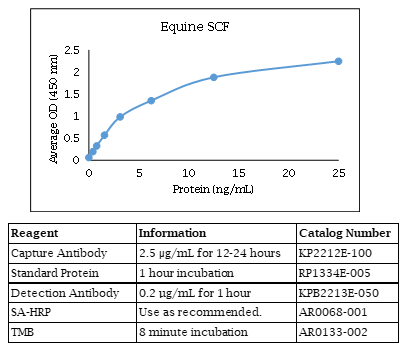
Equine SCF (Stem Cell Factor) ELISA
- Catalog Number:
- DIY2214E
- Availability:
- In stock
- Application:
- ELISA
- 100% Homology:
- Equus asinus (ass), Equus caballus (horse)
 Powered by Bioz
 Components
| Usage | Quantity | Component | Size |
|---|---|---|---|
| Detection Antibody | 50 µg | KPB2213E-050 | |
| Standard | 5 µg | RP1334E-005 | |
| Capture Antibody | 100 µg | KP2212E-100 | 1 Pack (<= 10 Plates) |
| Capture Antibody | 100 µg X 2 | KP2212E-100 | 1 Pack (<= 20 Plates) |
- The Equine SCF (Stem Cell Factor, also known as KIT Ligand or Steel Factor) ELISA is designed for the quantitative measurement of SCF in horse (Equus caballus) cell culture supernatants and can also be used to measure SCF in additional biological sample types reported in the literature, including serum, plasma, bone marrow aspirates, bronchoalveolar lavage (BAL) fluid, and tissue lysates, with minor protocol modifications recommended to optimize performance across different matrices. SCF is a hematopoietic growth factor produced by stromal cells, fibroblasts, endothelial cells, and other tissue-resident cells, and it functions through binding to the c-Kit (CD117) receptor to regulate hematopoietic stem cell survival, proliferation, and differentiation, as well as mast cell development, melanogenesis, and gametogenesis. In horses, SCF plays an important role in bone marrow homeostasis, immune cell development, tissue repair, and inflammatory responses. In healthy equine subjects, circulating SCF levels are typically low to moderate (often in the tens to low hundreds of pg/mL in serum or plasma), but concentrations may increase during hematopoietic activation, inflammatory airway disease (equine asthma), systemic inflammation, tissue injury, wound healing, or neoplastic conditions such as mast cell tumors and hematologic malignancies, depending on physiological and pathological context. Measurement of equine SCF provides valuable insight into stem cell biology, mast cell regulation, immune activation, and regenerative or inflammatory processes in veterinary and translational research settings. The ELISA kit contains a capture antibody, detection antibody, and recombinant equine SCF protein standard validated for use together in an ELISA format; kit components are not supplied in matched quantities and may be purchased separately. This product is for research use only, not for use in diagnostic or therapeutic procedures, and is manufactured in the USA.
| Storage Conditions | 2°C to 8°C or -20°C |
| Country Of Origin | USA |
Equine Stem Cell Factor (SCF) (also known as KIT ligand, KITLG, mast cell growth factor, or steel factor) is a cytokine and growth factor that plays an important role in hematopoiesis, stem cell maintenance, and immune cell development in horses (Equus caballus). SCF belongs to a group of hematopoietic growth factors that regulate the survival, proliferation, and differentiation of stem and progenitor cells. It functions by binding to the c-Kit receptor (CD117), a receptor tyrosine kinase expressed on hematopoietic stem cells, mast cells, melanocytes, and germ cells, activating intracellular signaling pathways such as PI3K/AKT, MAPK, and JAK/STAT that regulate cell survival, proliferation, and differentiation. In horses, SCF is produced by stromal cells, fibroblasts, endothelial cells, and epithelial cells, and exists in both membrane-bound and soluble forms, allowing both localized and systemic regulation of c-Kit–expressing cells. Equine SCF contributes to bone marrow hematopoiesis, mast cell development, pigmentation, and reproductive cell biology, and plays a role in maintaining the hematopoietic stem cell niche. Because horses are increasingly studied in regenerative medicine and stem cell–based therapies, characterization of equine SCF supports research on hematopoietic stem cell regulation, tissue regeneration, and immune cell development, with relevance to equine health, wound healing, and musculoskeletal repair.
Citations
Please choose a size to see price