Slide 1 of 1 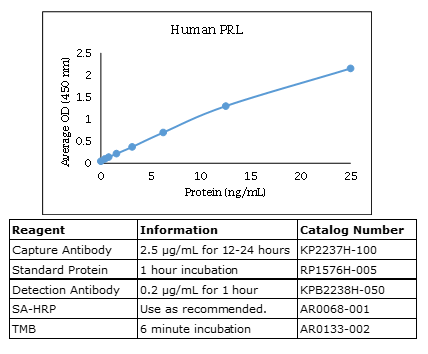
Human Prolactin ELISA
- Catalog Number:
- DIY2239H
- Availability:
- In stock
- Application:
- ELISA
- 100% Homology:
- Homo sapiens (human)
 Powered by Bioz
 Components
| Usage | Quantity | Component | Size |
|---|---|---|---|
| Detection Antibody | 50 µg | KPB2238H-050 | |
| Standard | 5 µg | RP1576H-005 | |
| Capture Antibody | 100 µg | KP2237H-100 | 1 Pack (<= 10 Plates) |
| Capture Antibody | 100 µg X 2 | KP2237H-100 | 1 Pack (<= 20 Plates) |
- The Human Prolactin (PRL) ELISA is designed for the quantitative measurement of prolactin in human cell culture supernatants and can also be used to measure prolactin in additional biological sample types reported in the literature, including serum, plasma, cerebrospinal fluid (CSF), breast milk, and tissue lysates, with minor protocol modifications recommended to optimize performance across different matrices. Prolactin is a peptide hormone primarily produced and secreted by lactotroph cells of the anterior pituitary gland, and it plays a central role in lactation, mammary gland development, reproductive function, and modulation of immune responses. In addition to its endocrine function, prolactin can act in an autocrine and paracrine manner in immune cells, influencing lymphocyte proliferation, cytokine production, and immune regulation. In healthy adults, circulating prolactin levels typically range from approximately 5-20 ng/mL in men and non-pregnant women, with higher levels observed during pregnancy, lactation, stress, and sleep. Elevated prolactin concentrations (hyperprolactinemia) may occur in pituitary adenomas (prolactinomas), hypothyroidism, renal insufficiency, and certain psychiatric or endocrine disorders. Measurement of human prolactin provides valuable insight into pituitary function, reproductive endocrinology, lactation physiology, stress responses, and neuroendocrine-immune interactions in clinical and translational research settings. The ELISA kit contains a capture antibody, detection antibody, and recombinant human prolactin protein standard validated for use together in an ELISA format; kit components are not supplied in matched quantities and may be purchased separately. This product is for research use only, not for use in diagnostic or therapeutic procedures, and is manufactured in the USA.
| Storage Conditions | 2°C to 8°C or -20°C |
| Country Of Origin | USA |
Human Prolactin (PRL) is a peptide hormone belonging to the prolactin/growth hormone family, which also includes growth hormone (GH) and placental lactogen (CSH) that regulate growth, metabolism, and reproductive physiology. Prolactin is produced primarily by lactotroph cells in the anterior pituitary gland and signals through the prolactin receptor (PRLR), activating intracellular pathways such as JAK2/STAT5, MAPK, and PI3K, which regulate gene expression and cellular responses. The hormone plays a central role in lactation, stimulating mammary gland development and milk production following childbirth. In addition to its role in reproduction, prolactin influences immune regulation, metabolism, reproductive function, and behavior, and can be produced by several extrapituitary tissues including immune cells, the uterus, and mammary tissue. Dysregulation of prolactin levels is associated with disorders such as hyperprolactinemia, infertility, and prolactin-secreting pituitary adenomas (prolactinomas). Because prolactin participates in both endocrine and immune signaling, human PRL is widely studied in reproductive endocrinology, immune regulation, and pituitary disease, contributing to understanding of hormone signaling pathways and their roles in human health and disease.
Citations
Please choose a size to see price