Slide 1 of 1 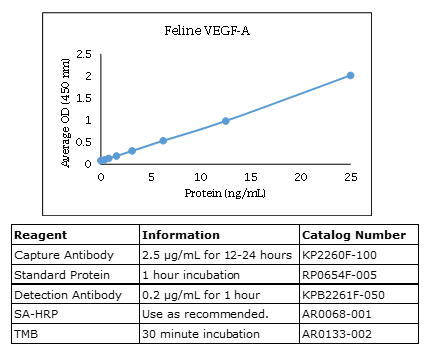
Feline VEGF-A ELISA
- Catalog Number:
- DIY2262F
- Availability:
- In stock
- Application:
- ELISA
- 100% Homology:
- Acinonyx jubatus (cheetah), Felis catus (domestic cat), Leopardus geoffroyi (Geoffroy's cat), Lynx pardinus (Spanish lynx), Prionailurus bengalensis (leopard cat), Puma concolor (puma)
 Powered by Bioz
 Components
| Usage | Quantity | Component | Size |
|---|---|---|---|
| Detection Antibody | 50 µg | KPB2261F-050 | |
| Standard | 5 µg | RP0654F-005 | |
| Capture Antibody | 100 µg | KP2260F-100 | 1 Pack (<= 10 Plates) |
| Capture Antibody | 100 µg X 2 | KP2260F-100 | 1 Pack (<= 20 Plates) |
- The Feline VEGF-A (Vascular Endothelial Growth Factor A) ELISA is designed for the quantitative measurement of VEGF-A in cat (Felis catus) cell culture supernatants and can also be used to measure VEGF-A in additional biological sample types reported in the literature, including serum, plasma, aqueous humor, pleural or peritoneal effusions, and tissue lysates, with minor protocol modifications recommended to optimize performance across different matrices. The feline VEGF-A protein sequence is identical to that of Acinonyx jubatus (cheetah), Lynx pardinus (Spanish lynx), Puma concolor (puma), Prionailurus bengalensis (leopard cat), and Leopardus geoffroyi (Geoffroy's cat), enabling this assay to be used for accurate detection across these closely related felid species. VEGF-A is a potent pro-angiogenic growth factor produced by endothelial cells, macrophages, fibroblasts, tumor cells, and other cell types in response to hypoxia, inflammation, and growth factor signaling, and it functions primarily through VEGFR-1 (Flt-1) and VEGFR-2 (KDR/Flk-1) to promote endothelial cell proliferation, migration, vascular permeability, and new blood vessel formation. In healthy domestic and wild felids, circulating VEGF-A levels are typically low to moderate, but concentrations may increase during neoplastic conditions such as lymphoma, mammary carcinoma, squamous cell carcinoma, and other solid tumors, as well as in inflammatory diseases, wound healing, chronic kidney disease, cardiomyopathy-associated vascular remodeling, and ocular diseases involving neovascularization. Measurement of feline VEGF-A provides valuable insight into angiogenesis, tumor progression, vascular permeability, hypoxia-driven signaling, and evaluation of anti-angiogenic or targeted therapeutic strategies in veterinary, wildlife, and translational research settings. The ELISA kit contains a capture antibody, detection antibody, and recombinant feline VEGF-A protein standard validated for use together in an ELISA format; kit components are not supplied in matched quantities and may be purchased separately. This product is for research use only, not for use in diagnostic or therapeutic procedures, and is manufactured in the USA.
| Storage Conditions | 2°C to 8°C or -20°C |
| Country Of Origin | USA |
Feline Vascular Endothelial Growth Factor A (VEGF-A) is a member of the vascular endothelial growth factor (VEGF) family, which includes VEGF-A, VEGF-B, VEGF-C, VEGF-D, and placental growth factor (PlGF)—key regulators of angiogenesis and vascular development. In cats (Felis catus), VEGF-A is produced by a variety of cells including endothelial cells, macrophages, fibroblasts, epithelial cells, and tumor cells, particularly in response to hypoxia, inflammation, or tissue injury. VEGF-A exerts its biological effects primarily through binding to VEGF receptor-1 (VEGFR-1/Flt-1) and VEGF receptor-2 (VEGFR-2/KDR) on endothelial cells, activating intracellular signaling pathways such as MAPK/ERK, PI3K/AKT, and PLCγ, which promote endothelial cell proliferation, migration, vascular permeability, and new blood vessel formation. In feline physiology, VEGF-A plays important roles in normal vascular development, wound healing, and tissue repair. Dysregulated VEGF-A expression is associated with tumor angiogenesis in feline cancers, including mammary carcinoma, squamous cell carcinoma, and lymphoma, where increased VEGF signaling supports tumor growth and metastasis by promoting blood vessel formation. Because angiogenesis is a key process in both cancer progression and tissue regeneration, feline VEGF-A is studied in veterinary oncology, vascular biology, and regenerative medicine, contributing to understanding of angiogenic signaling and potential therapeutic targets in cats.
Citations
Please choose a size to see price