Slide 1 of 1 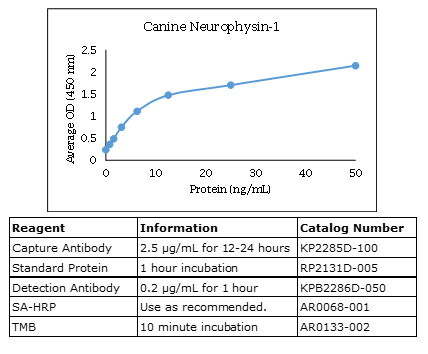
Canine Neurophysin-1 ELISA
- Catalog Number:
- DIY2287D
- Availability:
- In stock
- Application:
- ELISA
- 100% Homology:
- Canis lupus familiaris (dog)
 Powered by Bioz
 Components
| Usage | Quantity | Component | Size |
|---|---|---|---|
| Detection Antibody | 50 µg | KPB2286D-050 | |
| Standard | 5 µg | RP2131D-005 | |
| Capture Antibody | 100 µg | KP2285D-100 | 1 Pack (<= 10 Plates) |
| Capture Antibody | 100 µg X 2 | KP2285D-100 | 1 Pack (<= 20 Plates) |
- The Canine Neurophysin-1 ELISA is designed for the quantitative measurement of Neurophysin-1 in dog (Canis lupus familiaris) cell culture supernatants and can also be used to measure Neurophysin-1 in additional biological sample types reported in the literature, including serum, plasma, cerebrospinal fluid (CSF), and hypothalamic or pituitary tissue lysates, with minor protocol modifications recommended to optimize performance across different matrices. Neurophysin-1 is a carrier protein derived from the preprohormone precursor of arginine vasopressin (AVP) and is synthesized in magnocellular neurons of the hypothalamus, where it binds vasopressin during axonal transport to the posterior pituitary and is co-secreted with AVP into circulation. Measurement of Neurophysin-1 serves as a stable surrogate marker for vasopressin production and release, as the two are generated in equimolar amounts from the same precursor molecule. In healthy dogs, circulating Neurophysin-1 levels are typically low but detectable and may increase in response to dehydration, stress, hypovolemia, or osmotic changes that stimulate vasopressin secretion. In veterinary and translational research, canine Neurophysin-1 is particularly relevant in studies of water balance disorders such as central and nephrogenic diabetes insipidus, syndrome of inappropriate antidiuretic hormone secretion (SIADH)-like states, congestive heart failure, chronic kidney disease, neurologic injury, and endocrine dysfunction. Measurement of canine Neurophysin-1 provides valuable insight into hypothalamic-pituitary axis activity, vasopressin regulation, fluid homeostasis, and neuroendocrine disease mechanisms in both clinical and comparative medicine research settings. The ELISA kit contains a capture antibody, detection antibody, and recombinant canine Neurophysin-1 protein standard validated for use together in an ELISA format; kit components are not supplied in matched quantities and may be purchased separately. This product is for research use only, not for use in diagnostic or therapeutic procedures, and is manufactured in the USA.
| Storage Conditions | 2°C to 8°C or -20°C |
| Country Of Origin | USA |
Canine Neurophysin-1 is a carrier protein involved in the synthesis, processing, and transport of the neurohypophyseal hormone oxytocin in dogs (Canis lupus familiaris). Neurophysin-1 is produced as part of a larger precursor protein, preprooxyphysin, in magnocellular neurons of the hypothalamus, particularly within the paraventricular and supraoptic nuclei. During post-translational processing, the precursor is cleaved to generate oxytocin and its associated carrier protein, neurophysin-1. Canine neurophysin-1 binds oxytocin with high affinity, facilitating its proper folding, intracellular transport along axons, and storage in secretory vesicles within the posterior pituitary gland. Upon neuronal stimulation, oxytocin and neurophysin-1 are released together into the circulation. Through this coordinated processing and secretion pathway, neurophysin-1 plays an essential role in regulating oxytocin-mediated physiological functions such as uterine contraction during parturition, milk ejection during lactation, and aspects of social and reproductive behavior in dogs. In cell culture and neuroendocrine research, recombinant canine neurophysin-1 or expression constructs are used to study neurohypophyseal hormone biosynthesis, peptide hormone processing, and mechanisms of hormone storage and secretion in neuroendocrine cells.
Citations
Please choose a size to see price