Slide 1 of 1 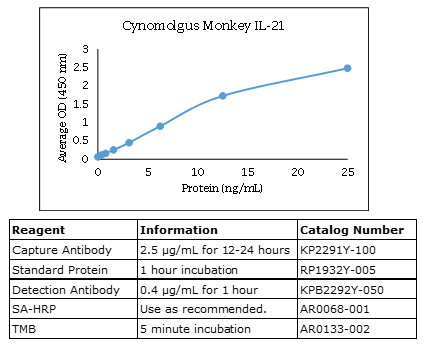
Cynomolgus Monkey IL-21 ELISA
- Catalog Number:
- DIY2293Y
- Availability:
- In stock
- Application:
- ELISA
- 100% Homology:
- Macaca fascicularis (crab-eating macaque), Macaca mulatta (Rhesus monkey), Macaca nemestrina (pig-tailed macaque)
 Powered by Bioz
 Components
| Usage | Quantity | Component | Size |
|---|---|---|---|
| Detection Antibody | 50 µg | KPB2292Y-050 | |
| Standard | 5 µg | RP1932Y-005 | |
| Capture Antibody | 100 µg | KP2291Y-100 | 1 Pack (<= 10 Plates) |
| Capture Antibody | 100 µg X 2 | KP2291Y-100 | 1 Pack (<= 20 Plates) |
- The Cynomolgus Monkey IL-21 (Interleukin-21) ELISA is designed for the quantitative measurement of IL-21 in cell culture supernatants from Cynomolgus monkeys (Macaca fascicularis) and can also be used to measure IL-21 in additional biological sample types reported in the literature, including serum, plasma, bronchoalveolar lavage (BAL) fluid, and tissue lysates, with minor protocol modifications recommended to optimize performance across different matrices. The Cynomolgus monkey IL-21 protein sequence is identical to that of Rhesus monkey (Macaca mulatta), enabling this assay to be used for accurate detection in both species. IL-21 is a pleiotropic cytokine produced primarily by activated CD4⁺ T cells, particularly T follicular helper (Tfh) cells and Th17 cells, and it signals through the IL-21 receptor (IL-21R) in combination with the common γ chain (γc) to regulate B cell differentiation, antibody production, germinal center formation, CD8⁺ T cell function, and NK cell activity. In healthy non-human primates, circulating IL-21 levels are typically low or near the limit of detection, but concentrations may increase during viral infection, vaccine-induced immune activation, autoimmune responses, or experimental immune stimulation, depending on immune status and timing of sampling. Measurement of Cynomolgus monkey IL-21 provides valuable insight into humoral immune responses, T cell-B cell interactions, cellular immunity, and evaluation of biologic therapeutics or vaccine candidates in preclinical safety and efficacy studies. The ELISA kit contains a capture antibody, detection antibody, and recombinant Cynomolgus monkey IL-21 protein standard validated for use together in an ELISA format; kit components are not supplied in matched quantities and may be purchased separately. This product is for research use only, not for use in diagnostic or therapeutic procedures, and is manufactured in the USA.
| Storage Conditions | 2°C to 8°C or -20°C |
| Country Of Origin | USA |
Cynomolgus monkey IL-21 (Interleukin-21) is a cytokine of the common γ chain (γc) family that plays a central role in regulating adaptive immune responses in Cynomolgus monkeys (Macaca fascicularis). The IL-21 protein is highly conserved among non-human primates and closely homologous to that of Rhesus monkey and humans, supporting its strong translational relevance. IL-21 is produced primarily by activated CD4⁺ T cells, particularly T follicular helper (Tfh) cells and Th17 cells, following antigen stimulation. It signals through the IL-21 receptor (IL-21R) in association with the common γ chain, activating downstream JAK/STAT pathways—predominantly STAT3—to regulate gene expression in B cells, T cells, and natural killer (NK) cells. IL-21 promotes B cell proliferation, plasma cell differentiation, immunoglobulin class switching, and antibody production, while enhancing CD8⁺ T cell cytotoxic function and NK cell activity. In healthy Cynomolgus monkeys, basal IL-21 expression is generally low but increases during infection, vaccination, and immune activation. Cynomolgus monkeys serve as important preclinical models for human infectious diseases (including viral infections such as SIV), autoimmune disorders, transplantation, and immuno-oncology. In translational and safety pharmacology research, IL-21 is studied as a biomarker of T cell–dependent B cell help and humoral immunity and as a target or readout in evaluation of vaccines, biologics, and immunotherapeutic agents.
Citations
Please choose a size to see price