Slide 1 of 1 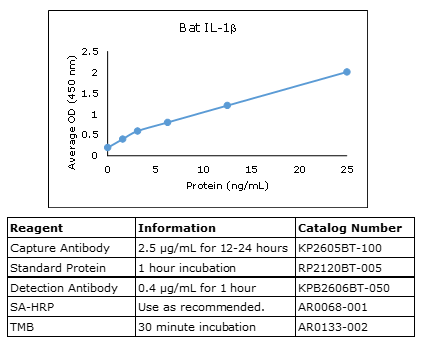
Egyptian Rousette Bat IL-1 beta ELISA
- Catalog Number:
- DIY2607BT
- Availability:
- In stock
- Application:
- ELISA
- 100% Homology:
- Rousettus aegyptiacus (Egyptian rousette)
 Powered by Bioz
 Components
| Usage | Quantity | Component | Size |
|---|---|---|---|
| Detection Antibody | 50 µg | KPB2606BT-050 | |
| Standard | 5 µg | RP2120BT-005 | |
| Capture Antibody | 100 µg | KP2605BT-100 | 1 Pack (<= 10 Plates) |
| Capture Antibody | 100 µg X 2 | KP2605BT-100 | 1 Pack (<= 20 Plates) |
- The Egyptian Rousette Bat IL-1β (Interleukin-1 beta) ELISA is designed for the quantitative measurement of IL-1β in cell culture supernatants from Egyptian rousette bats (Rousettus aegyptiacus) and can also be used to measure IL-1β in additional biological sample types reported in the literature, including serum, plasma, bronchoalveolar lavage (BAL) fluid, and tissue lysates, with minor protocol modifications recommended to optimize performance across different matrices. IL-1β is a potent pro-inflammatory cytokine produced primarily by activated monocytes, macrophages, and dendritic cells following inflammasome activation and caspase-1-mediated cleavage of pro-IL-1β, and it plays a central role in fever induction, leukocyte recruitment, endothelial activation, and amplification of inflammatory signaling cascades. In healthy Egyptian rousette bats, circulating IL-1β levels are typically very low or near the limit of detection, but concentrations may increase during viral or bacterial infection, tissue injury, or experimental immune stimulation, depending on pathogen exposure and timing of sampling. In bat immunology and emerging infectious disease research, IL-1β serves as an important biomarker of innate immune activation and inflammasome activity, particularly in studies of zoonotic pathogens for which Egyptian rousette bats are recognized natural reservoir hosts, including Marburg virus and related filoviruses. Measurement of Egyptian rousette bat IL-1β provides valuable insight into inflammatory regulation, host-pathogen interactions, and mechanisms underlying bat tolerance to viral infection. The ELISA kit contains a capture antibody, detection antibody, and recombinant Egyptian rousette bat IL-1β protein standard validated for use together in an ELISA format; kit components are not supplied in matched quantities and may be purchased separately. This product is for research use only, not for use in diagnostic or therapeutic procedures, and is manufactured in the USA.
| Storage Conditions | 2°C to 8°C or -20°C |
| Country Of Origin | USA |
Egyptian Rousette Bat (Rousettus aegyptiacus) Interleukin-1 Beta (IL-1β) is a potent pro-inflammatory cytokine produced primarily by activated macrophages and other innate immune cells following inflammasome activation in response to infection or tissue injury. Like in other mammals, IL-1β is synthesized as an inactive precursor (pro–IL-1β) and requires cleavage by caspase-1 within the inflammasome complex to become biologically active, after which it signals through the IL-1 receptor (IL-1R1) to activate NF-κB and MAPK pathways that drive fever, leukocyte recruitment, and amplification of inflammatory responses. In R. aegyptiacus, a natural reservoir host for filoviruses such as Marburg virus, IL-1β is of particular interest because bats are capable of controlling viral replication while exhibiting limited clinical inflammation, suggesting tightly regulated inflammasome and IL-1β signaling. Characterization of IL-1β responses in Egyptian Rousette bats supports studies of innate immune activation, viral tolerance, and mechanisms that prevent excessive immunopathology during infection. Understanding IL-1β dynamics in this species enhances its value as a reservoir host model for emerging zoonotic viruses and provides comparative insight into inflammatory regulation and host–pathogen interactions relevant to human infectious disease research.
Citations
Please choose a size to see price