Slide 1 of 1 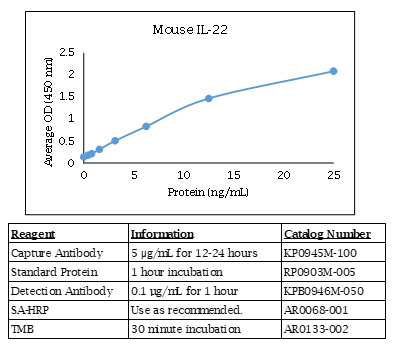
Mouse IL-22 Polyclonal Antibody
- Catalog Number:
- KP0945M
- Availability:
- In stock
- Application:
- ELISA, ELISpot, Flow Cytometry, Neutralization, Western Blot
- Host:
- Rabbit
- 100% Homology:
- Mus musculus (house mouse)
- Label:
- Unconjugated
 Powered by Bioz
 - The Mouse IL-22 polyclonal antibody is unlabeled and has been qualified for use in ELISA and Western blot applications. It is the capture antibody in the Kingfisher Biotech Mouse IL-22 ELISA. The Mouse IL-22 antibody was produced in chickens and is antigen-affinity purified. The reactivity by species is: (Chicken IL-22 - None) (Mouse IL-22 - Strong) (Swine IL-22 - None). For research use only.
| Storage Conditions | 2°C to 8°C |
| Purification | Antigen-affinity |
| Country Of Origin | USA |
Mouse IL-22 (Interleukin-22) is a member of the IL-10 cytokine family that plays a critical role in mucosal immunity and epithelial barrier protection in mice (Mus musculus). IL-22 is produced primarily by Th17 and Th22 CD4⁺ T cells, as well as by γδ T cells and innate lymphoid cells (ILC3s), in response to microbial infection and inflammatory stimulation. It signals through the IL-22 receptor complex (IL-22R1 and IL-10R2), which is expressed mainly on epithelial and stromal cells, activating downstream JAK/STAT pathways—particularly STAT3—to induce antimicrobial peptide production (e.g., RegIIIγ), enhance chemokine expression, promote epithelial cell proliferation, and support tissue repair. In healthy mice, basal IL-22 expression is generally low but increases during bacterial and fungal infections, especially at mucosal surfaces of the gastrointestinal and respiratory tracts. Mouse IL-22 has been extensively studied in models of colitis, inflammatory bowel disease, psoriasis-like dermatitis, bacterial pneumonia, and metabolic inflammation, where it can have protective or pathogenic roles depending on context. In biomedical research, mouse IL-22 serves as a key mediator of mucosal defense, epithelial regeneration, and host–pathogen interactions, and is widely used to investigate mechanisms of barrier immunity and inflammatory disease.
Citations
Please choose a size to see price
RELATED MEDIA

