Slide 1 of 1 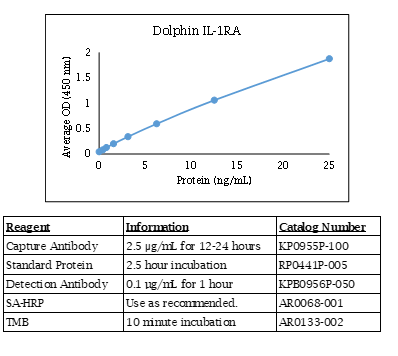
Dolphin Receptor Antagonist (IL-1RA) Polyclonal Antibody
- Catalog Number:
- KP0955P
- Availability:
- In stock
- Application:
- ELISA, ELISpot, Flow Cytometry, Neutralization, Western Blot
- Host:
- Rabbit
- 100% Homology:
- Delphinapterus leucas (beluga whale), Globicephala melas (long-finned pilot whale), Monodon monoceros (narwhal), Phocoena sinus (vaquita), Tursiops truncatus (common bottlenose dolphin)
- Label:
- Unconjugated
 Powered by Bioz
 - The Dolphin IL-1 Receptor Antagonist (IL-1ra) polyclonal antibody is unlabeled and has been qualified for use in ELISA and Western blot applications. It is the capture antibody in the Kingfisher Biotech Dolphin IL-1 Receptor Antagonist ELISA. The Dolphin IL-1 Receptor Antagonist antibody was produced in rabbits and is antigen-affinity purified. The reactivity by species is: (Bovine IL-1RA - None) (Canine IL-1RA - None) (Chicken IL-1RA - None) (Dolphin IL-1RA - Strong) (Equine IL-1RA - None) (Mouse IL-1RA - None) (Swine IL-1RA - Weak). For research use only.
| Storage Conditions | 2°C to 8°C |
| Purification | Antigen-affinity |
| Country Of Origin | USA |
Dolphin Interleukin-1 Receptor Antagonist (IL-1Ra) is an anti-inflammatory cytokine produced by monocytes, macrophages, and other immune cells in dolphins, particularly the bottlenose dolphin (Tursiops truncatus), where it functions as a key regulator of IL-1–mediated inflammatory responses. IL-1Ra competitively binds to the IL-1 receptor type 1 (IL-1R1) without initiating intracellular signaling, thereby blocking the pro-inflammatory effects of IL-1α and IL-1β and limiting activation of NF-κB and MAPK pathways that drive fever, leukocyte recruitment, and systemic inflammation. In dolphin health, IL-1Ra likely plays an important role in moderating inflammatory conditions associated with respiratory infections, bacterial and fungal dermatitis, wound healing, and systemic inflammatory responses, as well as in controlling inflammation linked to environmental stressors such as pollutant exposure and harmful algal blooms. As dolphins are long-lived marine mammals and sentinel species for ocean health, IL-1Ra serves as a valuable marker of anti-inflammatory regulation and immune balance in both managed and free-ranging populations. In comparative and conservation research, characterization of dolphin IL-1Ra supports studies of cytokine network regulation, resolution of inflammation, environmental immunotoxicology, and host resilience mechanisms, contributing to broader understanding of inflammatory control in marine mammals and translational insights into IL-1–mediated diseases in humans.
Citations
Please choose a size to see price
RELATED MEDIA

