Slide 1 of 1 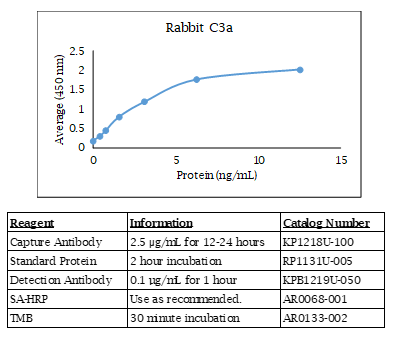
Rabbit C3a Polyclonal Antibody
- Catalog Number:
- KP1218U
- Availability:
- In stock
- Application:
- ELISA, ELISpot, Flow Cytometry, Neutralization, Western Blot
- Host:
- Chicken
- 100% Homology:
- Oryctolagus cuniculus (rabbit)
- Label:
- Unconjugated
 Powered by Bioz
 - The Rabbit C3a polyclonal antibody is unlabeled and has been qualified for use in ELISA and Western blot applications. It is the capture antibody in the Kingfisher Biotech Rabbit C3a ELISA. The Rabbit C3a antibody was produced in chickens and is antigen-affinity purified. For research use only. Made in the USA.
| Storage Conditions | 2°C to 8°C |
| Purification | Antigen-affinity |
| Country Of Origin | USA |
Rabbit C3a is a biologically active anaphylatoxin generated during activation of the complement cascade in rabbits (Oryctolagus cuniculus). It is produced by proteolytic cleavage of complement component C3 and functions as a potent mediator of innate immune and inflammatory responses. C3a binds to the C3a receptor (C3aR) expressed on neutrophils, monocytes, macrophages, mast cells, endothelial cells, and other immune and stromal cells, triggering chemotaxis, cytokine release, histamine release, increased vascular permeability, and amplification of inflammatory signaling. In healthy rabbits, circulating C3a levels are typically low but rise rapidly during complement activation induced by bacterial or viral infection, immune complex formation, endotoxemia, ischemia-reperfusion injury, or experimental immune challenge. In biomedical research, rabbit C3a is particularly relevant in models of sepsis, atherosclerosis, ocular inflammation, immune complex–mediated disease, and cardiovascular injury, where rabbits are commonly used due to their suitability for vascular and lipid metabolism studies. Measurement of rabbit C3a provides valuable insight into complement activation, acute inflammatory responses, and innate immune regulation in experimental disease models.
Citations
Please choose a size to see price
RELATED MEDIA

