Slide 1 of 1 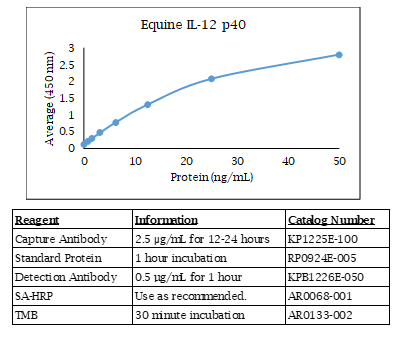
Equine IL-12/IL-23 p40 Polyclonal Antibody
- Catalog Number:
- KP1225E
- Availability:
- In stock
- Application:
- ELISA, ELISpot, Flow Cytometry, Neutralization, Western Blot
- Host:
- Rabbit
- 100% Homology:
- Equus caballus (horse)
- Label:
- Unconjugated
 Powered by Bioz
 - The Equine IL-12 (IL-23) p40 polyclonal antibody is unlabeled and has been qualified for use in ELISA and Western blot applications. It is the capture antibody in the Kingfisher Biotech Equine IL-12 (IL-23) p40 ELISA. The Equine IL-12 (IL-23) p40 antibody was produced in rabbits and is antigen-affinity purified. The reactivity by species is: (Bovine IL-12 p40 - Weak) (Chicken IL-12 p40 - Weak) (Equine IL-12 p40 - Strong) (Ovine IL-12 p40 - Moderate) (Swine IL-12 p40 - Moderate). For research use only.
| Storage Conditions | 2°C to 8°C |
| Purification | Antigen-affinity |
| Country Of Origin | USA |
Equine Interleukin-12/Interleukin-23 p40 (IL-12/IL-23 p40) is a cytokine subunit that plays an important role in regulating immune responses in horses (Equus caballus). The p40 subunit is shared by two heterodimeric cytokines, IL-12 and IL-23, where it pairs with the p35 subunit to form IL-12 and with the p19 subunit to form IL-23. These cytokines are produced primarily by activated antigen-presenting cells, including macrophages and dendritic cells, in response to microbial infection or inflammatory stimuli. Equine IL-12/IL-23 p40 contributes to activation of natural killer (NK) cells and differentiation of T helper cells toward Th1-type immune responses, promoting production of interferon-γ (IFN-γ) and enhancing cell-mediated immunity against intracellular pathogens. Through IL-23 signaling, the p40 subunit also supports maintenance and expansion of Th17 cells involved in inflammatory and host defense pathways. In horses, IL-12/IL-23 p40 participates in immune responses against bacterial, viral, and parasitic infections and is studied in the context of equine diseases such as Rhodococcus equi pneumonia and equine herpesvirus infections. Due to its role in regulating cellular immunity, equine IL-12/IL-23 p40 is widely studied in veterinary immunology and translational research, including investigations of host–pathogen interactions, vaccine responses, and immune-mediated inflammatory conditions relevant to both equine health and comparative biomedical research.
Citations
Please choose a size to see price
RELATED MEDIA

