Slide 1 of 1 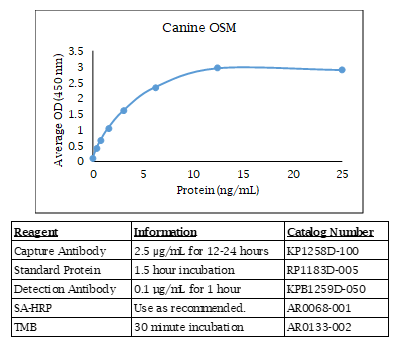
Canine Oncostatin M (OSM) Polyclonal Antibody
- Catalog Number:
- KP1258D
- Availability:
- In stock
- Application:
- ELISA, ELISpot, Flow Cytometry, Neutralization, Western Blot
- Host:
- Rabbit
- 100% Homology:
- Canis lupus dingo (dingo), Canis lupus familiaris (dog)
- Label:
- Unconjugated
 Powered by Bioz
 - The Canine Oncostatin M (OSM) polyclonal antibody is unlabeled and has been qualified for use in ELISA and Western blot applications. It is the capture antibody in the Kingfisher Biotech Canine Oncostatin M ELISA. The Canine Oncostatin M antibody was produced in rabbits and is antigen-affinity purified. The reactivity by species is: (Bovine OSM - None) (Canine OSM - Strong) (Mouse OSM - None). For research use only.
| Storage Conditions | 2°C to 8°C |
| Purification | Antigen-affinity |
| Country Of Origin | USA |
Canine Oncostatin M (OSM) is a multifunctional cytokine belonging to the IL-6 family of cytokines, which includes IL-6, IL-11, leukemia inhibitory factor (LIF), cardiotrophin-1 (CT-1), ciliary neurotrophic factor (CNTF), cardiotrophin-like cytokine factor 1 (CLCF1), and IL-27. In dogs (Canis lupus familiaris), OSM signals through receptor complexes containing the shared gp130 subunit, typically pairing with the OSM receptor (OSMR) or leukemia inhibitory factor receptor (LIFR), leading to activation of intracellular signaling pathways such as JAK/STAT3, MAPK, and PI3K. Canine OSM is produced primarily by activated T lymphocytes, macrophages, and neutrophils and functions in regulation of inflammation, hematopoiesis, and tissue remodeling. In canine health, OSM-mediated signaling is associated with inflammatory and degenerative conditions including canine osteoarthritis, dermatitis, and chronic inflammatory diseases, where it contributes to regulation of cytokine networks, matrix remodeling, and immune cell activation. OSM has also been implicated in cancer biology, including canine mammary tumors and osteosarcoma, where IL-6 family signaling pathways can influence tumor growth, tumor microenvironment remodeling, and immune responses. As a regulator of inflammation and tissue remodeling, canine OSM is important for studies of immune signaling, inflammatory disease mechanisms, and tumor biology, and contributes to comparative research using dogs as translational models for human inflammatory and musculoskeletal diseases.
Citations
Please choose a size to see price
RELATED MEDIA

