Slide 1 of 1 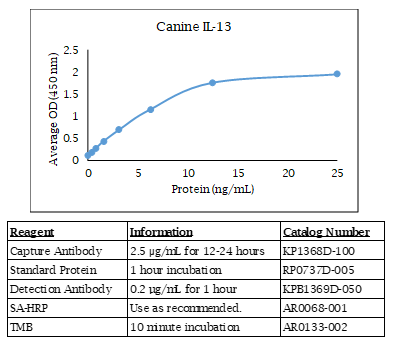
Canine IL-13 Polyclonal Antibody
- Catalog Number:
- KP1368D
- Availability:
- In stock
- Application:
- ELISA, ELISpot, Flow Cytometry, Neutralization, Western Blot
- Host:
- Rabbit
- 100% Homology:
- Canis lupus familiaris (dog)
- Label:
- Unconjugated
 Powered by Bioz
 - Anti-canine IL-13 polyclonal antibody (catalog KP1368D) is made in rabbits, affinity-purified (canine IL-13 affinity chromatography) and supplied in PBS containing 0.09% NaN₃; it was raised against recombinant canine IL-13 (immunogen) and the calculated molecular weight of canine IL-13 is ~12.3 kDa. Store at 2-8°C (stable up to 12 months from date of receipt). Recommended working concentrations are Western blot 0.1-2 µg/mL and ELISA 1-5 µg/mL (optimize per assay); typical sandwich ELISA reagent pairings and suggested conditions are provided on the datasheet (capture antibody KP1368D; standard protein RP0737D-005; detection antibody KPB1369D-050; streptavidin-HRP AR0068-001; TMB substrate AR0133-002). In cross-reactivity testing (ELISA) this antibody shows no reactivity to bovine, caprine, chicken, equine, human, mouse, ovine, rabbit, swine or zebrafish IL-13, and weak reactivity to dolphin. It is commonly used for ELISA, ELISpot, flow cytometry, neutralization, and Western blot applications (users should validate and optimize conditions for each application). The product is made in the USA, supplied for research applications only, and is not intended for medicinal, diagnostic, or therapeutic use.
| Storage Conditions | 2°C to 8°C |
| Purification | Antigen-affinity |
| Country Of Origin | USA |
Canine Interleukin-13 (IL-13) is a Th2-associated cytokine produced primarily by activated CD4⁺ T helper 2 (Th2) cells and other type 2 immune cells in dogs (Canis lupus familiaris), where it plays a central role in allergic inflammation, mucosal immunity, and tissue remodeling. IL-13 signals through receptor complexes composed of IL-13Rα1 and IL-4Rα, activating JAK/STAT6 pathways that promote alternative macrophage activation, IgE-associated immune responses, mucus production, and modulation of pro-inflammatory cytokine signaling. In canine health, IL-13 is particularly relevant in allergic and atopic conditions such as atopic dermatitis, food allergies, eosinophilic airway disease, and certain forms of inflammatory bowel disease, where elevated Th2 cytokine activity contributes to pruritus, eosinophilic infiltration, and chronic tissue inflammation. IL-13 also influences immune responses during parasitic infections by supporting type 2 immunity and tissue repair. Dysregulated IL-13 expression may contribute to chronic allergic inflammation or fibrosis. As a biomarker of Th2 polarization, canine IL-13 is important in studies of allergic disease pathogenesis, vaccine responses, and immune modulation. In translational research, dogs serve as valuable spontaneous models for human atopic dermatitis and allergic airway disease, and characterization of canine IL-13 supports comparative investigations into type 2–mediated inflammation and development of targeted anti-cytokine therapies relevant to both veterinary and human medicine.
Citations
Please choose a size to see price
RELATED MEDIA

