Slide 1 of 1 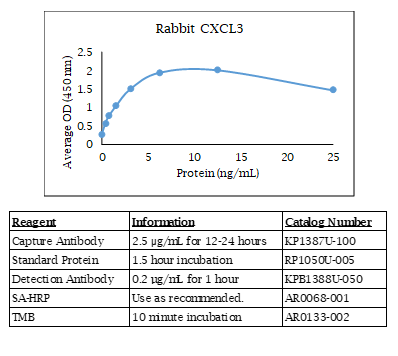
Rabbit CXCL3 Polyclonal Antibody
- Catalog Number:
- KP1387U
- Availability:
- In stock
- Application:
- ELISA, ELISpot, Flow Cytometry, Neutralization, Western Blot
- Host:
- Chicken
- 100% Homology:
- Oryctolagus cuniculus (rabbit)
- Label:
- Unconjugated
 Powered by Bioz
 - The Rabbit CXCL3 (GRO gamma) polyclonal antibody is unlabeled and has been qualified for use in ELISA and Western blot applications. It is the capture antibody in the Kingfisher Biotech Rabbit CXCL3 ELISA. The Rabbit CXCL3 antibody was produced in chickens and is antigen-affinity purified. The reactivity by species is: (Rabbit CXCL3 - Strong). For research use only.
| Storage Conditions | 2°C to 8°C |
| Purification | Antigen-affinity |
| Country Of Origin | USA |
Rabbit CXCL3 (C-X-C motif chemokine ligand 3), also known as GRO-γ (growth-regulated oncogene gamma), is a proinflammatory chemokine belonging to the CXC chemokine family, which also includes CXCL1 (GRO-α) and CXCL2 (GRO-β) that regulate neutrophil recruitment during inflammatory responses. In rabbits (Oryctolagus cuniculus), CXCL3 is produced by macrophages, epithelial cells, endothelial cells, and fibroblasts in response to proinflammatory cytokines such as IL-1β and TNF-α, microbial infection, or tissue injury. CXCL3 primarily signals through the chemokine receptor CXCR2, which is expressed on neutrophils and other innate immune cells, promoting chemotaxis, activation, and migration of neutrophils to sites of infection or inflammation. In rabbits, CXCL3 contributes to innate immune defense and regulation of acute inflammatory responses, particularly in tissues such as the skin, lung, and vascular endothelium. Rabbits are commonly used as animal models for inflammatory and cardiovascular diseases, including atherosclerosis, where CXCL3-mediated recruitment of neutrophils and other leukocytes to vascular tissues contributes to vascular inflammation and development of atherosclerotic lesions. Consequently, rabbit CXCL3 is studied in immunology and cardiovascular research to better understand chemokine-driven leukocyte recruitment and inflammatory disease mechanisms.
Citations
Please choose a size to see price
RELATED MEDIA

