Slide 1 of 1 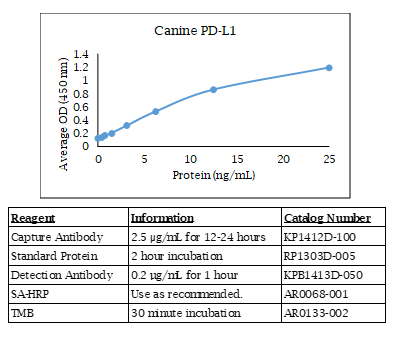
Canine PD-L1 Polyclonal Antibody
- Catalog Number:
- KP1412D
- Availability:
- In stock
- Application:
- ELISA, ELISpot, Flow Cytometry, Neutralization, Western Blot
- Host:
- Rabbit
- 100% Homology:
- Canis lupus dingo (dingo), Canis lupus familiaris (dog)
- Label:
- Unconjugated
 Powered by Bioz
 - Anti-canine PD-L1 polyclonal antibody (catalog KP1412D) is made in rabbits, affinity-purified by canine PD-L1 affinity chromatography and supplied in PBS containing 0.09% NaN₃; it was raised against recombinant canine PD-L1 (immunogen) and the calculated molecular weight of canine PD-L1 is ~24.7 kDa. Store at 2-8°C (stable up to 12 months from date of receipt). The antibody is supplied for ELISA (recommended 1-5 µg/mL; optimize per assay) and typical sandwich ELISA reagent pairings and suggested conditions are provided on the datasheet (capture antibody KP1412D; standard protein RP1303D-005; detection antibody KPB1413D; streptavidin-HRP AR0068-001; TMB substrate AR0133-002). In cross-reactivity testing (ELISA) this antibody shows no reactivity to rabbit PD-L1. It is commonly used for ELISA, ELISpot, flow cytometry, neutralization, and Western blot applications (users should validate and optimize conditions for each application). The product is made in the USA, supplied for research applications only, and is not intended for medicinal, diagnostic, or therapeutic use.
| Storage Conditions | 2°C to 8°C |
| Purification | Antigen-affinity |
| Country Of Origin | USA |
Canine Programmed Death-Ligand 1 (PD-L1) (CD274, also known as B7-H1) is an immune checkpoint protein that plays a critical role in regulating T cell activation and immune tolerance in dogs (Canis lupus familiaris). PD-L1 is a member of the B7 family of immunoregulatory proteins, which includes molecules such as PD-L2 (CD273), CD80 (B7-1), and CD86 (B7-2) that regulate T cell costimulatory and coinhibitory signaling. PD-L1 is expressed on antigen-presenting cells such as macrophages and dendritic cells, as well as epithelial cells, endothelial cells, and various tumor cells, and interacts with its receptor PD-1 (Programmed Death-1, CD279) on activated T lymphocytes. Binding of PD-L1 to PD-1 delivers inhibitory signals that suppress T cell proliferation, cytokine production, and cytotoxic activity, helping to maintain immune homeostasis and limit excessive inflammatory responses. In canine health, PD-L1 expression has been reported in several canine cancers, including oral melanoma, osteosarcoma, mast cell tumors, and lymphoma, where tumor-associated PD-L1 expression can contribute to immune evasion by inhibiting anti-tumor T cell responses. PD-L1 signaling may also regulate immune responses during chronic infections and inflammatory diseases. Because the PD-1/PD-L1 pathway is a major target of immune checkpoint therapy in human oncology, canine PD-L1 is increasingly studied in comparative oncology and veterinary immunotherapy, supporting development of checkpoint inhibitor therapies and improved understanding of tumor–immune system interactions in dogs.
Citations
Please choose a size to see price
RELATED MEDIA

