Slide 1 of 1 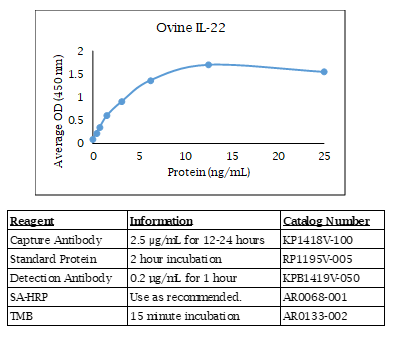
Ovine IL-22 Polyclonal Antibody
- Catalog Number:
- KP1418V
- Availability:
- In stock
- Application:
- ELISA, ELISpot, Flow Cytometry, Neutralization, Western Blot
- Host:
- Rabbit
- 100% Homology:
- Ovis aries (sheep)
- Label:
- Unconjugated
 Powered by Bioz
 - The Ovine IL-22 polyclonal antibody is unlabeled and has been qualified for use in ELISA and Western blot applications. It is the capture antibody in the Kingfisher Biotech Ovine IL-22 ELISA. The Ovine IL-22 antibody was produced in rabbits and is antigen-affinity purified. The reactivity by species is: (Caprine IL-22 - Moderate) (Chicken IL-22 - None) (Cynomolgus Monkey IL-22 - None) (Mouse IL-22 - None) (Ovine IL-22 - Strong) (Rabbit IL-22 - None) (Swine IL-22 - None). For research use only.
| Storage Conditions | 2°C to 8°C |
| Purification | Antigen-affinity |
| Country Of Origin | USA |
Ovine IL-22 (Interleukin-22) is a member of the IL-10 cytokine family that plays a critical role in mucosal immunity and epithelial barrier protection in sheep (Ovis aries). IL-22 is produced primarily by activated CD4⁺ T cells, including Th17- and Th22-like subsets, as well as by γδ T cells—which are prominent in ruminants—and innate lymphoid cells (ILC3s) in response to microbial infection and inflammatory stimulation. It signals through the IL-22 receptor complex (IL-22R1 and IL-10R2), expressed mainly on epithelial and stromal cells, activating downstream JAK/STAT pathways—particularly STAT3—to induce antimicrobial peptide production, enhance chemokine expression, promote epithelial cell proliferation, and support tissue repair. In healthy sheep, basal IL-22 expression is generally low but increases during bacterial, viral, and parasitic infections, especially at mucosal surfaces of the gastrointestinal, respiratory, and mammary tissues. Ovine IL-22 has been implicated in immune responses to gastrointestinal nematodes (e.g., Haemonchus contortus), Mycobacterium avium subspecies paratuberculosis, respiratory pathogens, and mastitis-causing bacteria. In veterinary and agricultural research, ovine IL-22 serves as a biomarker of mucosal immune activation and epithelial defense and is studied in the context of host–pathogen interactions, vaccine responses, and maintenance of barrier integrity in small ruminant health and production systems.
Citations
Please choose a size to see price
RELATED MEDIA

