Slide 1 of 1 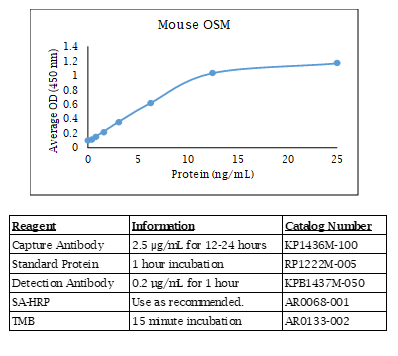
Mouse Oncostatin M (OSM) Polyclonal Antibody
- Catalog Number:
- KP1436M
- Availability:
- In stock
- Application:
- ELISA, ELISpot, Flow Cytometry, Neutralization, Western Blot
- Host:
- Rabbit
- 100% Homology:
- Mus musculus (house mouse)
- Label:
- Unconjugated
 Powered by Bioz
 - The Mouse Oncostatin M (OSM) polyclonal antibody is unlabeled and has been qualified for use in ELISA and Western blot applications. It is the capture antibody in the Kingfisher Biotech Mouse Oncostatin M ELISA. The Mouse Oncostatin M antibody was produced in rabbits and is antigen-affinity purified. The reactivity by species is: (Bovine OSM - None) (Canine OSM - None) (Human OSM - None) (Mouse OSM - Strong) (Swine CCL11 - None). For research use only.
| Storage Conditions | 2°C to 8°C |
| Purification | Antigen-affinity |
| Country Of Origin | USA |
Mouse Oncostatin M (OSM) is a multifunctional cytokine belonging to the IL-6 cytokine family, which also includes IL-6, IL-11, leukemia inhibitory factor (LIF), cardiotrophin-1 (CT-1), ciliary neurotrophic factor (CNTF), cardiotrophin-like cytokine factor 1 (CLCF1), and IL-27. In mice (Mus musculus), OSM signals through receptor complexes containing the shared gp130 (IL6ST) subunit together with the oncostatin M receptor (OSMR), activating downstream signaling pathways including JAK/STAT (particularly STAT3), MAPK, and PI3K/AKT. Murine OSM is produced primarily by activated T lymphocytes, macrophages, neutrophils, and dendritic cells and plays roles in regulating inflammation, hematopoiesis, immune responses, and tissue remodeling. In mouse models, OSM has been widely studied in experimental systems of inflammatory disease, fibrosis, and cancer, where it influences cytokine production, fibroblast activation, and extracellular matrix remodeling. OSM signaling is particularly relevant in murine models of rheumatoid arthritis, inflammatory bowel disease, lung inflammation, and liver fibrosis, where it contributes to chronic inflammatory signaling and tissue pathology. Because mice are the most widely used genetic model organism in biomedical research, characterization of mouse OSM has been instrumental in understanding IL-6 family cytokine signaling, STAT3-mediated inflammatory pathways, and mechanisms of tissue remodeling, providing insights relevant to human inflammatory and fibrotic diseases.
Citations
Please choose a size to see price
RELATED MEDIA

