Slide 1 of 1 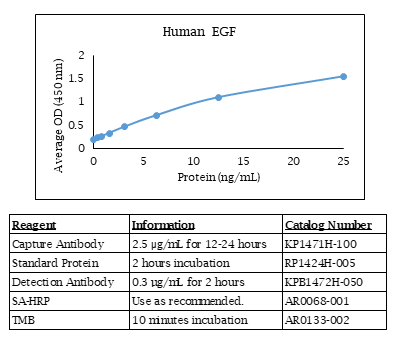
Human EGF Polyclonal Antibody
- Catalog Number:
- KP1471H
- Availability:
- In stock
- Application:
- ELISA, ELISpot, Flow Cytometry, Neutralization, Western Blot
- Host:
- Rabbit
- 100% Homology:
- Gorilla gorilla gorilla (western lowland gorilla), Homo sapiens (human), Pan paniscus (pygmy chimpanzee), Pan troglodytes (chimpanzee)
- Label:
- Unconjugated
 Powered by Bioz
 - The Human EGF polyclonal antibody is unlabeled and has been qualified for use in ELISA and Western blot applications. It is the capture antibody in the Kingfisher Human EGF ELISA. The Human EGF antibody was produced in rabbits and is antigen-affinity purified. The reactivity by species is: (Canine EGF - None) (Chicken EGF - None) (Human EGF - Strong) (Feline EGF - None) (Mouse EGF - None) (Swine EGF - None). For research use only.
- Canine EGF - None Chicken EGF - None Human EGF - Strong Feline EGF - None Mouse EGF - None Swine EGF - None
| Storage Conditions | 2°C to 8°C |
| Purification | Antigen-affinity |
| Country Of Origin | USA |
Human EGF (Epidermal Growth Factor) is a growth factor peptide belonging to the EGF family of ligands, which also includes transforming growth factor-α (TGF-α), amphiregulin (AREG), heparin-binding EGF-like growth factor (HB-EGF), betacellulin (BTC), and epiregulin (EREG) that signal through the epidermal growth factor receptor (EGFR/ErbB1) to regulate cell proliferation, differentiation, and tissue repair. In humans (Homo sapiens), EGF is produced by epithelial cells, fibroblasts, macrophages, and glandular tissues, particularly the salivary glands and gastrointestinal epithelium, where it plays important roles in maintenance and regeneration of epithelial tissues, including the skin, cornea, and intestinal lining. Binding of EGF to EGFR activates intracellular signaling pathways such as MAPK/ERK, PI3K–AKT, and JAK/STAT, promoting cell proliferation, survival, migration, and tissue remodeling during development and after injury. In human health, EGF is critical for wound healing, epithelial barrier maintenance, and tissue regeneration, and dysregulation of EGF–EGFR signaling is strongly associated with cancer development and progression, particularly in lung, colorectal, and head and neck cancers. Consequently, the EGF–EGFR signaling axis is a major focus of biomedical research and targeted cancer therapy, with EGFR inhibitors widely used as therapeutic agents in oncology.
Citations
Please choose a size to see price
RELATED MEDIA

