Slide 1 of 1 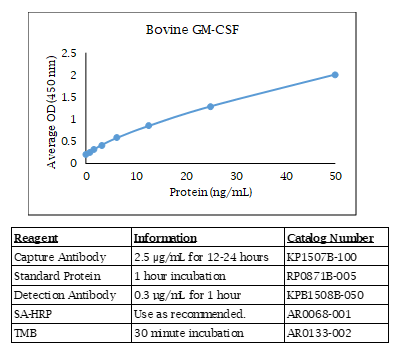
Bovine GM-CSF Polyclonal Antibody
- Catalog Number:
- KP1507B
- Availability:
- In stock
- Application:
- ELISA, ELISpot, Flow Cytometry, Neutralization, Western Blot
- Host:
- Rabbit
- 100% Homology:
- Bos taurus (cattle)
- Label:
- Unconjugated
 Powered by Bioz
 - The Bovine GM-CSF polyclonal antibody is unlabeled and has been qualified for use in ELISA and Western blot applications. It is the capture antibody in the Kingfisher Bovine GM-CSF ELISA. The Bovine GM-CSF antibody was produced in rabbits and is antigen-affinity purified. The reactivity by species is: (Bovine GM-CSF - Strong) (Canine GM-CSF - None) (Caprine GM-CSF - None) (Chicken GM-CSF - None) (Equine GM-CSF - None) (Feline GM-CSF - None) (Human GM-CSF - None) (Mouse GM-CSF - None) (Ovine GM-CSF - None) (Rabbit GM-CSF - None) (Rat GM-CSF - None) (Swine GM-CSF -None). For research use only.
| Storage Conditions | 2°C to 8°C |
| Purification | Antigen-affinity |
| Country Of Origin | USA |
Bovine GM-CSF (Granulocyte–Macrophage Colony-Stimulating Factor, CSF2) is a hematopoietic cytokine belonging to the colony-stimulating factor family, which also includes G-CSF (CSF3) and M-CSF (CSF1) that regulate the development, proliferation, and activation of myeloid immune cells. In cattle (Bos taurus), GM-CSF is produced by activated T lymphocytes, macrophages, endothelial cells, fibroblasts, and other stromal cells in response to infection, inflammatory cytokines, or immune stimulation. Bovine GM-CSF binds to the GM-CSF receptor (CSF2R) expressed on hematopoietic progenitor cells and mature myeloid cells, activating intracellular signaling pathways such as JAK/STAT, MAPK/ERK, and PI3K–AKT, which promote the proliferation and differentiation of granulocytes, macrophages, and dendritic cells, as well as enhance their functional activity in innate and adaptive immune responses. In bovine health, GM-CSF contributes to host defense against bacterial infections, particularly by regulating macrophage and neutrophil activity in tissues such as the mammary gland and respiratory tract. Bovine GM-CSF has also been studied in animal models of bovine tuberculosis caused by Mycobacterium bovis, where GM-CSF influences macrophage activation and antigen-presenting cell development, helping researchers understand cell-mediated immunity and vaccine responses to mycobacterial infections relevant to both livestock health and human tuberculosis research.
Citations
Please choose a size to see price
RELATED MEDIA

