Slide 1 of 1 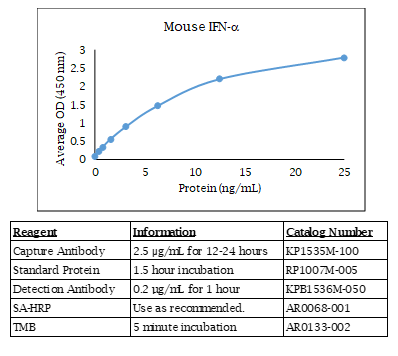
Mouse IFN alpha Polyclonal Antibody
- Catalog Number:
- KP1535M
- Availability:
- In stock
- Application:
- ELISA, ELISpot, Flow Cytometry, Neutralization, Western Blot
- Host:
- Rabbit
- 100% Homology:
- Mus musculus (house mouse)
- Label:
- Unconjugated
 Powered by Bioz
 - The Mouse IFN alpha polyclonal antibody is unlabeled and has been qualified for use in ELISA and Western blot applications. It is the capture antibody in the Kingfisher Mouse IFN alpha ELISA. The Mouse IFN alpha antibody was produced in rabbits and is antigen-affinity purified. The reactivity by species is: (Bovine IFN-alphaA - Weak) (Canine IFN-alpha - None) (Caprine IFN-alpha - None) (Chicken IFN-alpha - None) (Equine IFN-alpha1 - Weak) (Ovine IFN-alpha - Weak) (Mouse IFN-alpha - Strong) (Swine IFN-alpha1 - Strong). For research use only.
| Storage Conditions | 2°C to 8°C |
| Purification | Antigen-affinity |
| Country Of Origin | USA |
Mouse Interferon-Alpha (IFN-α) is a type I interferon comprising multiple closely related subtypes produced primarily by plasmacytoid dendritic cells and virus-infected cells in mice (Mus musculus), where it serves as a critical mediator of early innate antiviral immunity. Upon binding to the type I interferon receptor complex (IFNAR1/IFNAR2), murine IFN-α activates JAK/STAT signaling pathways, leading to induction of interferon-stimulated genes (ISGs) that inhibit viral replication, enhance antigen presentation, promote natural killer (NK) cell cytotoxicity, and shape adaptive immune responses. Mouse IFN-α is central to experimental models of viral infections including influenza virus, lymphocytic choriomeningitis virus (LCMV), murine cytomegalovirus (MCMV), West Nile virus, and SARS-CoV-2 (adapted strains), where timing and magnitude of interferon responses strongly influence viral control and immunopathology. Dysregulated or chronic IFN-α signaling has also been implicated in murine models of systemic lupus erythematosus, autoimmune disease, cancer, and interferonopathies. IFNAR-deficient and IFN-α transgenic mouse models have been instrumental in dissecting type I interferon biology, antiviral mechanisms, and immune-mediated tissue damage. As both a biomarker and functional regulator of host–pathogen interactions, mouse IFN-α remains central to preclinical research on antiviral therapies, vaccine development, cancer immunotherapy, and immune modulation strategies relevant to human disease.
Citations
Please choose a size to see price
RELATED MEDIA

