Slide 1 of 1 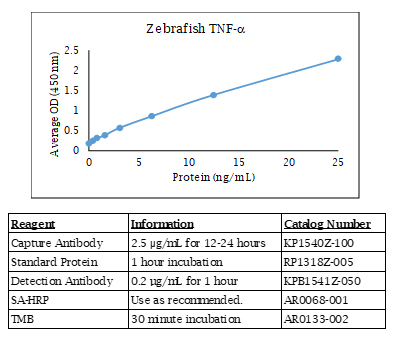
Zebrafish TNF alpha Polyclonal Antibody
- Catalog Number:
- KP1540Z
- Availability:
- In stock
- Application:
- ELISA, ELISpot, Flow Cytometry, Neutralization, Western Blot
- Host:
- Rabbit
- 100% Homology:
- Danio rerio (zebrafish)
- Label:
- Unconjugated
 Powered by Bioz
 - The Zebrafish TNF alpha polyclonal antibody is unlabeled and has been qualified for use in ELISA and Western blot applications. It is the capture antibody in the Kingfisher Zebrafish TNF alpha ELISA. The Zebrafish TNF alpha antibody was produced in rabbits and is antigen-affinity purified. The reactivity by species is: (Atlantic Salmon TNF-alpha - Strong) (Bovine TNF-alpha - None) (Canine TNF-alpha - None) (Caprine TNF-alpha - Weak) (Cynomolgus Monkey TNF-alpha - None) (Dolphin TNF-alpha - None) (Equine TNF-alpha - None) (Feline TNF-alpha - None) (Guinea Pig TNF-alpha - None) (Human TNF-alpha - None) (Mouse TNF-alpha - None) (Ovine TNF-alpha - None) (Rabbit TNF-alpha - None) (Swine TNF-alpha - None) (Zebrafish TNF-alpha - Strong). For research use only.
| Storage Conditions | 2°C to 8°C |
| Purification | Antigen-affinity |
| Country Of Origin | USA |
Zebrafish (Danio rerio) Tumor Necrosis Factor Alpha (TNF-α) is a proinflammatory cytokine that plays an important role in innate immune responses, inflammation, and host defense against pathogens in teleost fish. TNF belongs to the tumor necrosis factor (TNF) superfamily, a group of immune signaling molecules that includes TNF-α, lymphotoxins, Fas ligand (FasL), CD40 ligand (CD40L), and TRAIL, which regulate inflammatory signaling, apoptosis, and immune cell activation. In zebrafish, TNF is primarily produced by activated macrophages, neutrophils, and other innate immune cells following infection, tissue injury, or recognition of pathogen-associated molecular patterns. TNF signals through TNF receptor homologs that activate intracellular pathways such as NF-κB and MAPK, leading to induction of proinflammatory cytokines, antimicrobial responses, and recruitment of immune cells to sites of infection or injury. Zebrafish TNF plays important roles in defense against bacterial and mycobacterial infections, and it has been extensively studied in zebrafish models of Mycobacterium marinum infection, which serve as a model for human tuberculosis, where TNF signaling regulates macrophage activation and granuloma formation. Because zebrafish are widely used as a genetic and imaging model for immunology and infectious disease, characterization of zebrafish TNF has provided important insights into host–pathogen interactions, inflammatory signaling, and innate immune responses relevant to vertebrate immunity and human disease.
Citations
Please choose a size to see price
RELATED MEDIA

