Slide 1 of 1 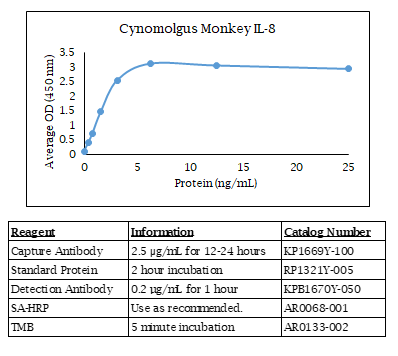
Cynomolgus Monkey IL-8 Polyclonal Antibody
- Catalog Number:
- KP1669Y
- Availability:
- In stock
- Application:
- ELISA, ELISpot, Flow Cytometry, Neutralization, Western Blot
- Host:
- Rabbit
- 100% Homology:
- Macaca fascicularis (crab-eating macaque), Macaca mulatta (Rhesus monkey), Macaca nemestrina (pig-tailed macaque)
- Label:
- Unconjugated
 Powered by Bioz
 - The Cynomolgus Monkey IL-8 (CXCL8) polyclonal antibody is unlabeled and has been qualified for use in ELISA and Western blot applications. It is the capture antibody in the Kingfisher Cynomolgus Monkey IL-8 ELISA. The Cynomolgus Monkey IL-8 antibody was produced in rabbits and is antigen-affinity purified. The reactivity by species is: (Bovine IL-8 - None) (Canine IL-8 - None) (Cynomolgus Monkey IL-8 - Strong) (Dolphin IL-8 - None) (Equine IL-8 - None) (Feline IL-8 - Weak) (Guinea Pig IL-8 - None) (Human IL-8 - Strong) (Ovine IL-8 - None) (Rabbit IL-8 - None) (Swine IL-8 - None). For research use only.
| Storage Conditions | 2°C to 8°C |
| Purification | Antigen-affinity |
| Country Of Origin | USA |
Cynomolgus Monkey (Macaca fascicularis) Interleukin-8 (IL-8), also known as CXCL8, is a potent pro-inflammatory chemokine that plays a central role in innate immune responses by mediating neutrophil chemotaxis, activation, and migration to sites of infection or tissue injury. Structurally and functionally highly homologous to human IL-8, cynomolgus IL-8 signals through CXCR1 and CXCR2 receptors to activate downstream pathways that drive neutrophil recruitment, degranulation, and amplification of inflammatory cascades. IL-8 is rapidly induced in response to viral, bacterial, and inflammatory stimuli and is elevated in nonhuman primate models of diseases such as dengue, influenza, SARS-CoV-2, tuberculosis, and bacterial sepsis, where its expression correlates with disease severity and pulmonary or systemic inflammation. Due to the close genetic and immunological similarity of cynomolgus monkeys to humans, IL-8 is widely used as a biomarker of immune activation in preclinical vaccine studies, infectious disease models, toxicology assessments, and evaluation of biologics targeting inflammatory pathways. Characterization of cynomolgus IL-8 is therefore critical for translational research into neutrophil-driven pathology, cytokine and chemokine network dynamics, and therapeutic modulation of inflammatory responses relevant to human infectious, autoimmune, and inflammatory diseases.
Citations
Please choose a size to see price
RELATED MEDIA

