Slide 1 of 1 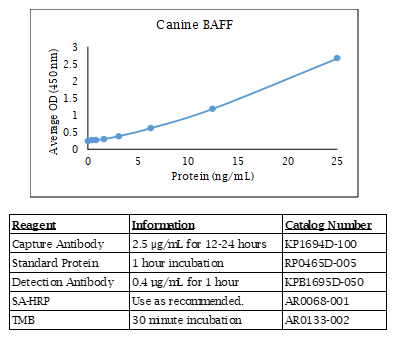
Canine BAFF Polyclonal Antibody
- Catalog Number:
- KP1694D
- Availability:
- In stock
- Application:
- ELISA, ELISpot, Flow Cytometry, Neutralization, Western Blot
- Host:
- Rabbit
- 100% Homology:
- Canis lupus dingo (dingo), Canis lupus familiaris (dog), Vulpes lagopus (Arctic fox), Vulpes vulpes (red fox)
- Label:
- Unconjugated
 Powered by Bioz
 - The Canine BAFF (TNFSF13B) polyclonal antibody is unlabeled and has been qualified for use in ELISA and Western blot applications. It is the capture antibody in the Kingfisher Canine BAFF ELISA. The Canine BAFF antibody was produced in rabbits and is antigen-affinity purified. The reactivity by species is: (Bovine BAFF - None) (Canine BAFF - Strong) (Chicken BAFF - None) (Equine BAFF - None) (Feline BAFF - None) (Mouse BAFF - Moderate) (Ovine BAFF - None) (Rabbit BAFF - None) (Swine BAFF - None). For research use only.
| Storage Conditions | 2°C to 8°C |
| Purification | Antigen-affinity |
| Country Of Origin | USA |
Canine BAFF (B cell–Activating Factor), also known as BLyS or TNFSF13B, is a member of the tumor necrosis factor (TNF) superfamily and plays a critical role in B cell development, survival, and humoral immunity in dogs (Canis lupus familiaris). BAFF is produced primarily by monocytes, macrophages, dendritic cells, and certain stromal cells, and it signals through the receptors BAFF-R (TNFRSF13C), TACI (TNFRSF13B), and BCMA (TNFRSF17) to promote B cell maturation, peripheral B cell survival, immunoglobulin class switching, and maintenance of long-lived plasma cells. In healthy dogs, BAFF supports normal antibody production and immune homeostasis; however, dysregulated or elevated BAFF expression may contribute to pathological B cell activation and autoantibody production. In veterinary and comparative medicine research, canine BAFF is particularly relevant in naturally occurring autoimmune diseases such as immune-mediated hemolytic anemia (IMHA), immune-mediated thrombocytopenia (IMTP), systemic lupus erythematosus (SLE)–like syndromes, and chronic inflammatory conditions, as well as in B cell–derived malignancies including lymphoma and multiple myeloma. Measurement and characterization of canine BAFF provide valuable insight into B cell–mediated immune regulation, antibody-driven pathology, and potential therapeutic strategies targeting BAFF signaling in both veterinary patients and translational immunology research.
Citations
Please choose a size to see price
RELATED MEDIA

