Slide 1 of 1 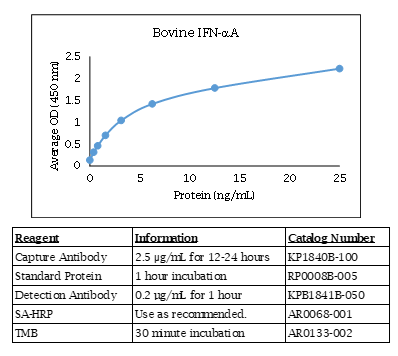
Bovine IFN alpha A Polyclonal Antibody
- Catalog Number:
- KP1840B
- Availability:
- In stock
- Application:
- ELISA, ELISpot, Flow Cytometry, Neutralization, Western Blot
- Host:
- Rabbit
- 100% Homology:
- Bos taurus (cattle)
- Label:
- Unconjugated
 Powered by Bioz
 - Anti-bovine IFN-αA polyclonal antibody (catalog KP1840B) is made in rabbits, affinity-purified by bovine IFN-αA affinity chromatography and supplied in PBS containing 0.09% NaN₃; it was raised against recombinant bovine IFN-αA (immunogen) and the calculated molecular weight of bovine IFN-αA is ~19.0 kDa. Store at 2-8°C (stable up to 12 months from date of receipt). Recommended working concentrations are Western blot 0.1-2 µg/mL and ELISA 1-5 µg/mL (optimize per assay); typical sandwich ELISA reagent pairings and suggested conditions are provided on the datasheet (capture antibody KP1840B; standard protein RP0008B-005; detection antibody KPB1841B-050; streptavidin-HRP AR0068-001; TMB substrate AR0133-002). In cross-reactivity testing (ELISA) this antibody shows weak reactivity to caprine and ovine IFN-α, and no reactivity to canine, chicken, equine, feline, human, mouse or swine IFN-α. It is commonly used for ELISA, ELISpot, flow cytometry, neutralization, and Western blot applications (users should validate and optimize conditions for each application). The product is made in the USA, supplied for research applications only, and is not intended for medicinal, diagnostic, or therapeutic use.
| Storage Conditions | 2°C to 8°C |
| Purification | Antigen-affinity |
| Country Of Origin | USA |
Bovine Interferon-Alpha A (IFN-αA) is a type I interferon subtype produced primarily by plasmacytoid dendritic cells and virus-infected cells in cattle (Bos taurus), where it plays a central role in early innate antiviral defense. Upon binding to the type I interferon receptor complex (IFNAR1/IFNAR2), bovine IFN-αA activates the JAK/STAT signaling pathway, leading to induction of interferon-stimulated genes (ISGs) that inhibit viral replication, enhance antigen presentation, and promote activation of natural killer (NK) cells and adaptive immune responses. In bovine health, IFN-αA is critically involved in host responses to economically significant viral infections such as bovine viral diarrhea virus (BVDV), bovine herpesvirus-1 (IBR), bovine respiratory syncytial virus (BRSV), foot-and-mouth disease virus (FMDV), and other components of the bovine respiratory disease (BRD) complex. Altered or suppressed IFN-α responses—such as immune evasion by BVDV—can contribute to viral persistence and increased disease severity. As both a biomarker and functional mediator of antiviral immunity, bovine IFN-αA is important in vaccine evaluation, antiviral strategy development, and immunopathogenesis studies. In translational research, characterization of bovine IFN-αA supports comparative studies of type I interferon biology, viral immune evasion mechanisms, and large-animal models of respiratory and systemic viral infection relevant to both veterinary and human medicine.
Citations
Please choose a size to see price
RELATED MEDIA

