Slide 1 of 1 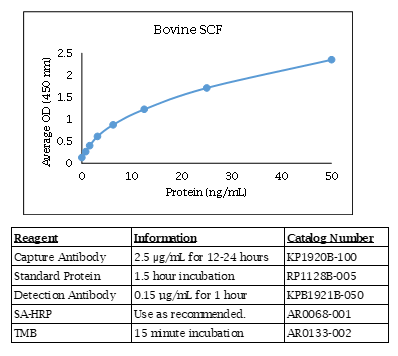
Bovine SCF (Stem Cell Factor) Polyclonal Antibody
- Catalog Number:
- KP1920B
- Availability:
- In stock
- Application:
- ELISA, ELISpot, Flow Cytometry, Neutralization, Western Blot
- Host:
- Rabbit
- 100% Homology:
- Bos taurus (cattle)
- Label:
- Unconjugated
 Powered by Bioz
 - The Bovine SCF polyclonal antibody is unlabeled and has been qualified for use in ELISA and Western blot applications. It is the capture antibody in the Kingfisher Bovine SCF ELISA. The Bovine SCF antibody was produced in rabbits and is antigen-affinity purified. The reactivity by species is: (Bovine SCF - Strong) (Canine SCF - None) (Chicken SCF - None) (Equine SCF - Weak) (Feline SCF - Weak) (Human SCF - None) (Mouse SCF - None) (Rabbit SCF - None) (Swine SCF - Moderate). For research use only.
| Storage Conditions | 2°C to 8°C |
| Purification | Antigen-affinity |
| Country Of Origin | USA |
Bovine Stem Cell Factor (SCF) (also known as KIT ligand, KITLG, mast cell growth factor, or steel factor) is a cytokine and growth factor that plays an important role in hematopoiesis, stem cell maintenance, and immune cell development in cattle (Bos taurus). SCF belongs to a group of hematopoietic growth factors that regulate the survival, proliferation, and differentiation of stem and progenitor cells. It exerts its biological effects by binding to the c-Kit receptor (CD117), a receptor tyrosine kinase expressed on hematopoietic stem cells, mast cells, melanocytes, and germ cells, activating intracellular signaling pathways such as PI3K/AKT, MAPK, and JAK/STAT that promote cell survival and growth. In cattle, SCF is produced by stromal cells, fibroblasts, endothelial cells, and epithelial cells and exists in both membrane-bound and soluble forms, allowing both local and systemic regulation of c-Kit–expressing cells. Bovine SCF plays roles in bone marrow hematopoiesis, mast cell development, pigmentation, and reproductive cell biology, and contributes to maintenance of hematopoietic stem cell niches. Because SCF–c-Kit signaling regulates stem cell function and immune cell development, bovine SCF is studied in research on hematopoiesis, mast cell biology, reproductive physiology, and stem cell–based regenerative approaches relevant to cattle health and livestock production.
Citations
Please choose a size to see price
RELATED MEDIA

