Slide 1 of 1 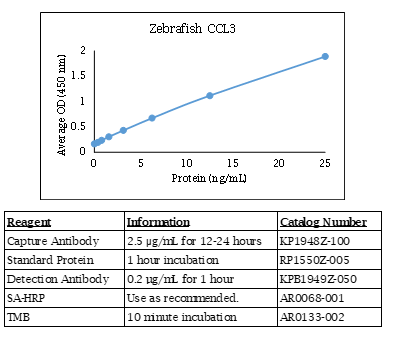
Zebrafish CCL3 (MIP-1 alpha) Polyclonal Antibody
- Catalog Number:
- KP1948Z
- Availability:
- In stock
- Application:
- ELISA, ELISpot, Flow Cytometry, Neutralization, Western Blot
- Host:
- Rabbit
- 100% Homology:
- Danio rerio (zebrafish)
- Label:
- Unconjugated
 Powered by Bioz
 - The Zebrafish CCL3 polyclonal antibody is unlabeled and has been qualified for use in ELISA and Western blot applications. It is the capture antibody in the Kingfisher Zebrafish CCL3 ELISA. The Zebrafish CCL3 antibody was produced in rabbits and is antigen-affinity purified. The reactivity by species is: (Bat CCL3 - None) (Bovine CCL3 - None) (Canine CCL3 - None) (Caprine CCL3 - None) (Cynomolgus Monkey CCL3 - None) (Equine CCL3 - None) (Feline CCL3 - None) (Ferret CCL3 - None) (Hamster CCL3 - None) (Human CCL3 - None) (Mouse CCL3 - None) (Ovine CCL3 - None) (Rabbit CCL3 - None) (Turkey CCL3 - None) (Zebrafish CCL3 - Strong). For research use only.
| Storage Conditions | 2°C to 8°C |
| Purification | Antigen-affinity |
| Country Of Origin | USA |
Zebrafish (Danio rerio) CCL3 (C-C motif chemokine ligand 3, also referred to as an MIP-1α–like chemokine in teleost fish) is a pro-inflammatory chemokine involved in recruitment and activation of immune cells during innate immune responses. Similar to mammalian CCL3, zebrafish CCL3-like chemokines function to attract macrophages, neutrophils, and other leukocytes to sites of infection, tissue injury, or inflammatory stimulation through chemokine receptor pathways related to CCR1/CCR5-like receptors in fish. In zebrafish, CCL3 expression is induced in macrophages, epithelial cells, and other immune-responsive tissues following exposure to pathogens, inflammatory cytokines, or tissue damage. The chemokine plays an important role in early innate immune responses, particularly during bacterial infections such as Mycobacterium marinum and other experimental infection models where macrophage recruitment and granuloma formation are key components of host defense. Because zebrafish larvae are transparent and genetically tractable, CCL3-mediated leukocyte recruitment can be visualized in real time using fluorescent reporter lines, making zebrafish a powerful model for studying chemokine-driven immune cell migration. Characterization of zebrafish CCL3-like signaling contributes to understanding of evolutionarily conserved chemokine networks, innate immune cell trafficking, and host–pathogen interactions, providing insights relevant to vertebrate immunology and inflammatory disease mechanisms.
Citations
Please choose a size to see price
RELATED MEDIA

