Slide 1 of 1 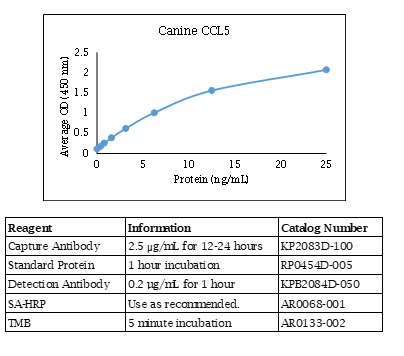
Canine CCL5 (RANTES) Polyclonal Antibody
- Catalog Number:
- KP2083D
- Availability:
- In stock
- Application:
- ELISA, ELISpot, Flow Cytometry, Neutralization, Western Blot
- Host:
- Rabbit
- 100% Homology:
- Canis lupus dingo (dingo), Canis lupus familiaris (dog)
- Label:
- Unconjugated
 Powered by Bioz
 - The Canine CCL5 polyclonal antibody is unlabeled and has been qualified for use in ELISA and Western blot applications. It is the capture antibody in the Kingfisher Biotech Canine CCL5 ELISA. The Canine CCL5 antibody was produced in rabbits and is antigen-affinity purified. The reactivity by species is: (Canine CCL5 - Strong) (Bovine CCL5 - None) (Chicken CCL5 - None) (Cynomolgus monkey CCL5 - None) (Dolphin CCL5 - None) (Equine CCL5 - None) (Feline CCL5 - None) (Ferret CCL5 - None) (Guinea pig CCL5 - None) (Hamster CCL5 - None) (Human CCL5 - None) (Mouse CCL5 - None) (Ovine CCL5 - None) (Rabbit CCL5 - None) (Swine CCL5 - None) (Turkey CCL5 - None). For research use only.
- Recombinant canine CCL5 - Strong Recombinant bovine CCL5 - None Recombinant chicken CCL5 - None Recombinant cynomolgus monkey CCL5 - None Recombinant dolphin CCL5 - None Recombinant equine CCL5 - None Recombinant feline CCL5 - None Recombinant ferret CCL5 - None Recombinant guinea pig CCL5 - None Re
| Storage Conditions | 2°C to 8°C |
| Purification | Antigen-affinity |
| Country Of Origin | USA |
Canine CCL5 (C–C motif chemokine ligand 5, also known as RANTES – Regulated upon Activation, Normal T cell Expressed and Secreted) is a proinflammatory chemokine that regulates immune cell recruitment, inflammatory signaling, and antiviral responses in dogs (Canis lupus familiaris). CCL5 belongs to the CC chemokine family, which also includes CCL3 (MIP-1α), CCL4 (MIP-1β), and CCL2 (MCP-1), chemokines that control leukocyte trafficking during immune activation. In dogs, CCL5 is produced primarily by activated T lymphocytes, macrophages, dendritic cells, platelets, and epithelial cells in response to infection, inflammatory stimuli, or tissue injury, and exerts its biological effects mainly through binding to the chemokine receptors CCR1, CCR3, and CCR5, promoting chemotaxis and activation of T cells, monocytes/macrophages, eosinophils, and natural killer (NK) cells at sites of inflammation. CCL5 contributes to immune responses against viral and bacterial pathogens and is involved in chronic inflammatory and immune-mediated diseases such as canine atopic dermatitis and inflammatory bowel disease. Because dogs naturally develop several diseases that resemble human conditions, including allergic skin disease, inflammatory bowel disease, and certain cancers, canine CCL5 is also studied in comparative animal models of human inflammatory and immune-mediated disorders, helping to understand chemokine-driven leukocyte recruitment, tumor microenvironment signaling, and therapeutic targeting of the CCL5–CCR5 pathway.
Citations
Please choose a size to see price
RELATED MEDIA

