Slide 1 of 1 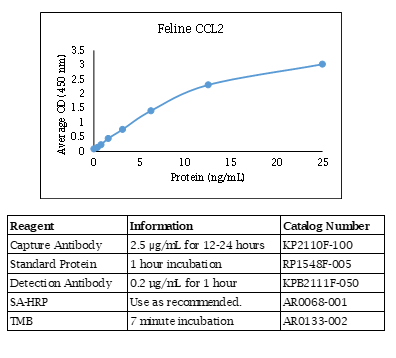
Feline CCL2 (MCP-1) Polyclonal Antibody
- Catalog Number:
- KP2110F
- Availability:
- In stock
- Application:
- ELISA, ELISpot, Flow Cytometry, Neutralization, Western Blot
- Host:
- Rabbit
- 100% Homology:
- Acinonyx jubatus (cheetah), Felis catus (domestic cat), Puma concolor (puma)
- Label:
- Unconjugated
 Powered by Bioz
 - The Feline CCL2 polyclonal antibody is unlabeled and has been qualified for use in ELISA and Western blot applications. It is the capture antibody in the Kingfisher Biotech Feline CCL2 ELISA. The Feline CCL2 antibody was produced in rabbits and is antigen-affinity purified. The Feline CCL2 polyclonal antibody has been shown to cross-react strongly with canine, equine, ferret, human, ovine, and swine CCL2. For research use only.
- Recombinant feline CCL2 - Strong Recombinant bovine CCL2 - Moderate Recombinant canine CCL2 - Strong Recombinant cynomolgus monkey CCL2 - Moderate Recombinant dolphin CCL2 - Moderate Recombinant equine CCL2 - Strong Recombinant ferret CCL2 - Strong Recombinant guinea pig CCL2 - None Recombinant huma
| Storage Conditions | 2°C to 8°C |
| Purification | Antigen-affinity |
| Country Of Origin | USA |
Feline CCL2 (C-C motif chemokine ligand 2, also known as monocyte chemoattractant protein-1, MCP-1) is a pro-inflammatory chemokine that plays a key role in recruitment and activation of monocytes, macrophages, and memory T cells during immune responses in cats (Felis catus). CCL2 signals primarily through the CCR2 receptor, activating downstream pathways that promote leukocyte migration, cytokine production, and coordination of innate and adaptive immune responses at sites of infection or tissue injury. In feline health, CCL2 is particularly relevant in inflammatory and infectious diseases such as feline infectious peritonitis (FIP) caused by feline coronavirus, feline immunodeficiency virus (FIV) infection, chronic kidney disease, and inflammatory bowel disease, where elevated CCL2 expression contributes to macrophage recruitment and local inflammatory pathology. While CCL2-mediated immune cell trafficking is essential for pathogen defense and tissue repair, dysregulated or excessive expression can drive chronic inflammation and immune-mediated tissue damage. As a biomarker of monocyte/macrophage recruitment and inflammatory activation, feline CCL2 is widely studied in investigations of host–pathogen interactions, immune regulation, and disease pathogenesis. Characterization of feline CCL2 supports veterinary research into inflammatory disease mechanisms and provides comparative insight into chemokine-driven immune responses relevant to human infectious and inflammatory disorders.
Citations
Please choose a size to see price
RELATED MEDIA

