Slide 1 of 1 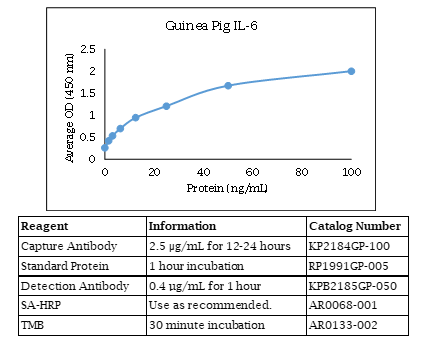
Guinea Pig IL-6 Polyclonal Antibody
- Catalog Number:
- KP2184GP
- Availability:
- In stock
- Application:
- ELISA, ELISpot, Flow Cytometry, Neutralization, Western Blot
- Host:
- Rabbit
- 100% Homology:
- Cavia porcellus (domestic guinea pig)
- Label:
- Unconjugated
 Powered by Bioz
 - The Guinea Pig IL-6 polyclonal antibody is unlabeled and has been qualified for use in ELISA and Western blot applications. It is the capture antibody in the Kingfisher Biotech Guinea Pig IL-6 ELISA. The Guinea Pig IL-6 antibody was produced in rabbits and is antigen-affinity purified. The reactivity by species is: (Guinea Pig IL-6 - Strong) (Atlantic Salmon IL-6 - None) (Bat IL-6 - None) (Bovine IL-6 - None) (Canine IL-6 - None) (Caprine IL-6 - None) (Chicken IL-6 - None) (Cynomolgus Monkey IL-6 - None) (Dolphin IL-6 - None) (Equine IL-6 - None) (Feline IL-6 - None) (Ferret IL-6 - None) (Human IL-6 - None) (Mouse IL-6 - None) (Ovine IL-6 - None) (Rabbit IL-6 - None) (Rat IL-6 - None) (Swine IL-6 - None) (Zebrafish IL-6 - None). For research use only.
- Recombinant guinea pig IL-6 - Strong Recombinant Atlantic salmon IL-6 - None Recombinant bat IL-6 - None Recombinant bovine IL-6 - None Recombinant canine IL-6 - None Recombinant caprine IL-6 - None Recombinant chicken IL-6 - None Recombinant cynomolgus IL-6 - None Recombinant dolphin IL-6 - None Re
| Storage Conditions | 2°C to 8°C |
| Purification | Antigen-affinity |
| Country Of Origin | USA |
Guinea Pig Interleukin-6 (IL-6) is a multifunctional pro-inflammatory cytokine and a central member of the IL-6 cytokine family—including IL-6, IL-11, IL-27, IL-31, leukemia inhibitory factor (LIF), oncostatin M (OSM), ciliary neurotrophic factor (CNTF), cardiotrophin-1 (CT-1), and cardiotrophin-like cytokine factor 1 (CLCF1)—which signal through receptor complexes containing the shared gp130 subunit to activate JAK/STAT and MAPK pathways. In guinea pigs (Cavia porcellus), IL-6 plays a critical role in regulating acute-phase responses, fever, leukocyte recruitment, and B- and T-cell differentiation during infection and inflammation. Guinea pigs are widely used as translational models for human infectious diseases, including tuberculosis, influenza, cytomegalovirus, and hemorrhagic fevers, where IL-6 expression correlates with pulmonary inflammation, systemic immune activation, and disease severity. Dysregulated IL-6 production contributes to immunopathology and tissue damage, making it an important biomarker for monitoring infection progression and evaluating vaccine or therapeutic efficacy. In both laboratory animal health and biomedical research, characterization of guinea pig IL-6 and related cytokine family members supports studies of host-pathogen interactions, respiratory and systemic inflammatory responses, and comparative immunology, reinforcing the guinea pig’s value as a model for human infectious and inflammatory diseases.
Citations
Please choose a size to see price
RELATED MEDIA

