Slide 1 of 1 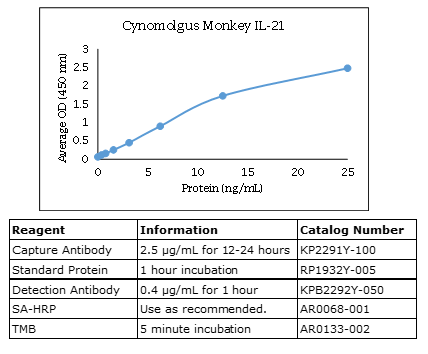
Cynomolgus Monkey IL-21 Polyclonal Antibody
- Catalog Number:
- KP2291Y
- Availability:
- In stock
- Application:
- ELISA, ELISpot, Flow Cytometry, Neutralization, Western Blot
- Host:
- Rabbit
- 100% Homology:
- Macaca fascicularis (crab-eating macaque), Macaca mulatta (Rhesus monkey), Macaca nemestrina (pig-tailed macaque)
- Label:
- Unconjugated
 Powered by Bioz
 - The Cynomolgus Monkey IL-21 polyclonal antibody is unlabeled and has been qualified for use in ELISA and Western blot applications. It is the capture antibody in the Kingfisher Biotech Cynomolgus Monkey IL-21 ELISA. The Cynomolgus Monkey IL-21 antibody was produced in rabbits and is antigen-affinity purified. This antibody has shown no cross-reactivity with atlantic salmon, bat, bovine, chicken, ovine, rabbit, or swine IL-21 proteins. For research use only.
| Storage Conditions | 2°C to 8°C |
| Purification | Antigen-affinity |
| Country Of Origin | USA |
Cynomolgus monkey IL-21 (Interleukin-21) is a cytokine of the common γ chain (γc) family that plays a central role in regulating adaptive immune responses in Cynomolgus monkeys (Macaca fascicularis). The IL-21 protein is highly conserved among non-human primates and closely homologous to that of Rhesus monkey and humans, supporting its strong translational relevance. IL-21 is produced primarily by activated CD4⁺ T cells, particularly T follicular helper (Tfh) cells and Th17 cells, following antigen stimulation. It signals through the IL-21 receptor (IL-21R) in association with the common γ chain, activating downstream JAK/STAT pathways—predominantly STAT3—to regulate gene expression in B cells, T cells, and natural killer (NK) cells. IL-21 promotes B cell proliferation, plasma cell differentiation, immunoglobulin class switching, and antibody production, while enhancing CD8⁺ T cell cytotoxic function and NK cell activity. In healthy Cynomolgus monkeys, basal IL-21 expression is generally low but increases during infection, vaccination, and immune activation. Cynomolgus monkeys serve as important preclinical models for human infectious diseases (including viral infections such as SIV), autoimmune disorders, transplantation, and immuno-oncology. In translational and safety pharmacology research, IL-21 is studied as a biomarker of T cell–dependent B cell help and humoral immunity and as a target or readout in evaluation of vaccines, biologics, and immunotherapeutic agents.
Citations
Please choose a size to see price
RELATED MEDIA

