Slide 1 of 1 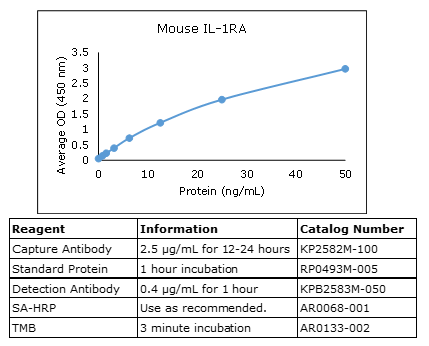
Mouse Receptor Antagonist (IL-1RA) Polyclonal Antibody
- Catalog Number:
- KP2582M
- Availability:
- In stock
- Application:
- ELISA, ELISpot, Flow Cytometry, Neutralization, Western Blot
- Host:
- Rabbit
- 100% Homology:
- Mus musculus (house mouse)
- Label:
- Unconjugated
 Powered by Bioz
 - The Mouse IL-1RA polyclonal antibody is unlabeled and has been qualified for use in ELISA and Western blot applications. It is the capture antibody in the Kingfisher Biotech Mouse IL-1RA ELISA. The Mouse IL-1RA antibody was produced in rabbits and is antigen-affinity purified. This antibody has not been show to cross-react with bat, bovine, canine, chicken, cynomolgus monkey, dolphin, equine, ferret, rabbit, or swine IL-1RA proteins. For research use only.
| Storage Conditions | 2°C to 8°C |
| Purification | Antigen-affinity |
| Country Of Origin | USA |
Mouse Interleukin-1 Receptor Antagonist (IL-1Ra) is an anti-inflammatory cytokine produced by monocytes, macrophages, neutrophils, and other immune and stromal cells in mice (Mus musculus) that functions as a key endogenous regulator of IL-1–mediated inflammation. IL-1Ra competitively binds to the IL-1 receptor type 1 (IL-1R1) without activating downstream signaling, thereby inhibiting the pro-inflammatory actions of IL-1α and IL-1β and limiting activation of NF-κB and MAPK pathways that drive fever, leukocyte recruitment, and tissue inflammation. Murine IL-1Ra plays a central role in maintaining immune homeostasis in experimental models of rheumatoid arthritis (e.g., collagen-induced arthritis), inflammatory bowel disease, sepsis, gout, neuroinflammation, and metabolic disorders. IL-1Ra–deficient mice spontaneously develop inflammatory polyarthritis, highlighting its critical function in controlling IL-1–driven pathology. As both a biomarker and therapeutic analog, mouse IL-1Ra is widely used in preclinical research to study inflammasome regulation, cytokine network balance, and the efficacy of IL-1–targeted therapies, providing foundational insight into inflammatory mechanisms and treatment strategies relevant to human autoimmune and inflammatory diseases.
Citations
Please choose a size to see price
RELATED MEDIA

